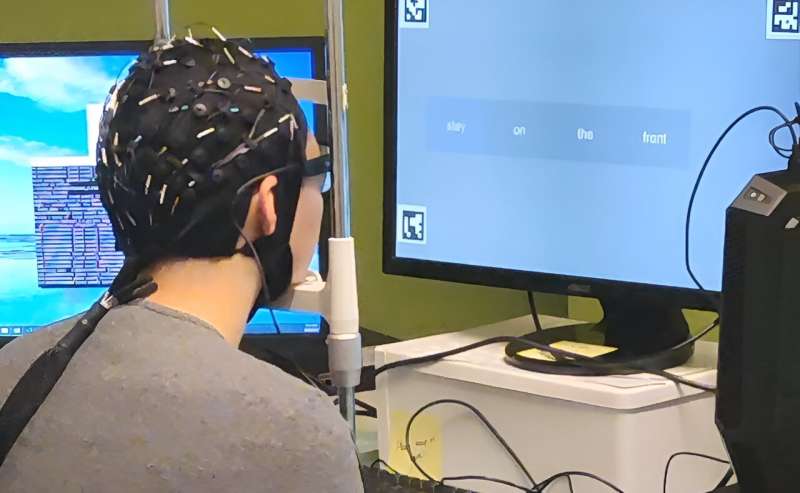
Scientists from the University of Technology Sydney (UTS) have unveiled a technology that many people thought was only possible in science fiction. It is an AI system that can translate your thoughts into readable text in real time without any surgery or hospital equipment.
The system is called DeWave and it works by reading the electrical signals your brain produces when you think. All a person needs to do is wear a lightweight cap fitted with sensors. No needles. No implants. No MRI machine.

How Does DeWave Work?
When you think or read silently your brain produces tiny electrical signals called brainwaves.
These signals travel across your scalp and can be detected by a technology called electroencephalography commonly known as EEG.
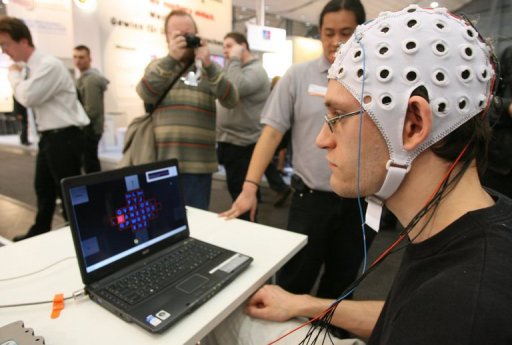
DeWave uses an EEG cap to capture these signals while a person reads or thinks quietly.
The AI then breaks the brainwave data into smaller pieces and looks for patterns. Each pattern gets linked to a specific word or phrase in the English language.
Charles Zhou from the UTS research team explained it simply. When you think about the word “hello” your brain sends a specific set of signals. DeWave was trained on thousands of such examples until it could recognize those patterns and produce the matching words.
How Accurate Is DeWave Right Now?
DeWave currently translates thoughts into text with around 40 percent accuracy.
That is a 3 percent improvement over the previous best result in EEG thought translation. In this field every single percentage point requires enormous effort.
The system is better at recognizing verbs than nouns.
Lead researcher Yiqun Duan noted that when it comes to nouns the AI tends to pick similar words rather than exact ones. For example it might produce “the man” when the correct word was “the author.”
Craig Jin from the University of Sydney put it in perspective. Just a few years ago EEG to text translations produced complete nonsense. The fact that results are now meaningful and nearly half accurate is a major leap forward.
What Makes DeWave Different?
Before DeWave the only ways to translate brain signals into text required either invasive brain surgery or long sessions inside an expensive MRI machine.
Elon Musk’s Neuralink for example requires a chip to be surgically implanted inside the brain. That is a serious medical procedure most people would never consider just to communicate differently.
DeWave changes everything.
The EEG cap is portable wearable and easy to use. You put it on like a pair of headphones and you are ready to go.
Professor Chin-Teng Lin the director of the GrapheneX-UTS AI Centre described it as non-intrusive reasonably priced and convenient.
This is also the first system in the world to translate raw EEG signals directly into English without any invasive procedures. That alone makes it a historic milestone in neuroscience and AI.
The research was selected as an important paper at NeurIPS which is one of the most respected machine learning conferences in the world.
Who Can Benefit from This Technology?
The most powerful application is in healthcare.
Millions of people around the world have lost the ability to speak due to stroke paralysis or ALS. For them communicating even the simplest thought can require enormous effort or may be impossible entirely.
DeWave could give these people a voice again without surgery or hospital equipment.
Beyond healthcare the technology also opens the door to a new kind of human machine interaction. Think controlling a robotic arm a wheelchair or a computer simply by thinking.
Researchers at UTS have already pointed to this as a key direction for future development.
What Comes Next for DeWave?
The UTS research team is actively working to push accuracy far beyond its current level.
Their stated goal is to reach 90 percent translation accuracy which would make the system reliable enough for real world everyday use.
Newer studies combining large language models like LLaMA and GPT-4 with EEG data are already showing promising results. Researchers are now talking about affordable thought to text systems as a near future reality not a distant dream.
Meta has also been working in a related space using a different brain scanning method called MEG to reconstruct speech from brain activity. The growing number of teams working on this problem suggests that breakthroughs are arriving faster than most people expected.
Source: arXiv (full paper)