Quick Summary
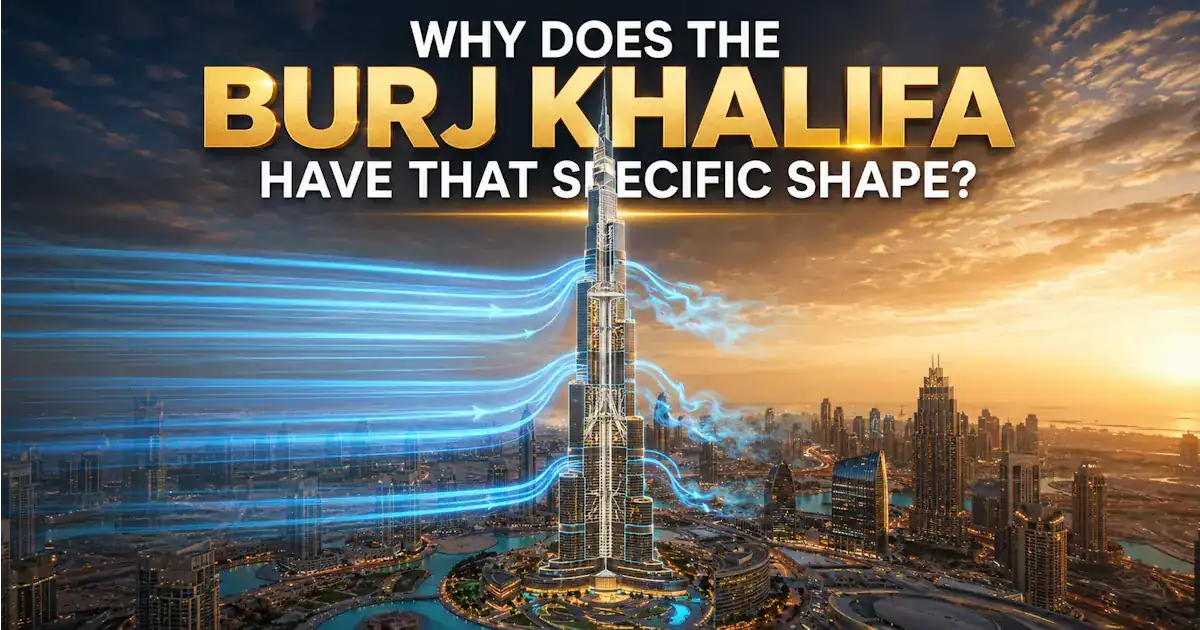
The Burj Khalifa’s shape comes down to one word: wind. At 828 meters tall, wind is more dangerous than gravity. The tower’s spiraling, Y-shaped form was designed specifically to break up wind forces before they could build into something dangerous. Every setback, every twist, and every taper was tested in a wind tunnel and refined based on real data. The cultural inspiration from a desert flower and Islamic geometry shaped how it looks. Wind engineering shaped whether it could actually stand.
The Real Problem Engineers Had to Solve First
Most people look at the Burj Khalifa and assume someone drew a striking silhouette and engineers figured out how to build it. That’s not what happened.
When Emaar Properties approached Skidmore, Owings & Merrill (SOM) in 2003 with the brief to build the world’s tallest building, the architects and engineers knew immediately that the visual design would have to come second. At heights above 800 meters, the real enemy isn’t gravity. It’s wind.
SOM’s Managing Architect for the project, George Efstathiou, put it plainly: “The first thing you need to understand is you need to be very respectful of the laws of nature: wind, heat, and gravity.”
So before a single aesthetic decision was made, the team had to answer one question: how do you build something this tall without the wind tearing it apart?
The answer became the shape.
Why the Burj Khalifa Has a Giant Y Shape
Look down at the Burj Khalifa from above and you’ll see something like a three-pointed star. Three wings spread outward from a central hexagonal core, each at 120 degrees from the others.
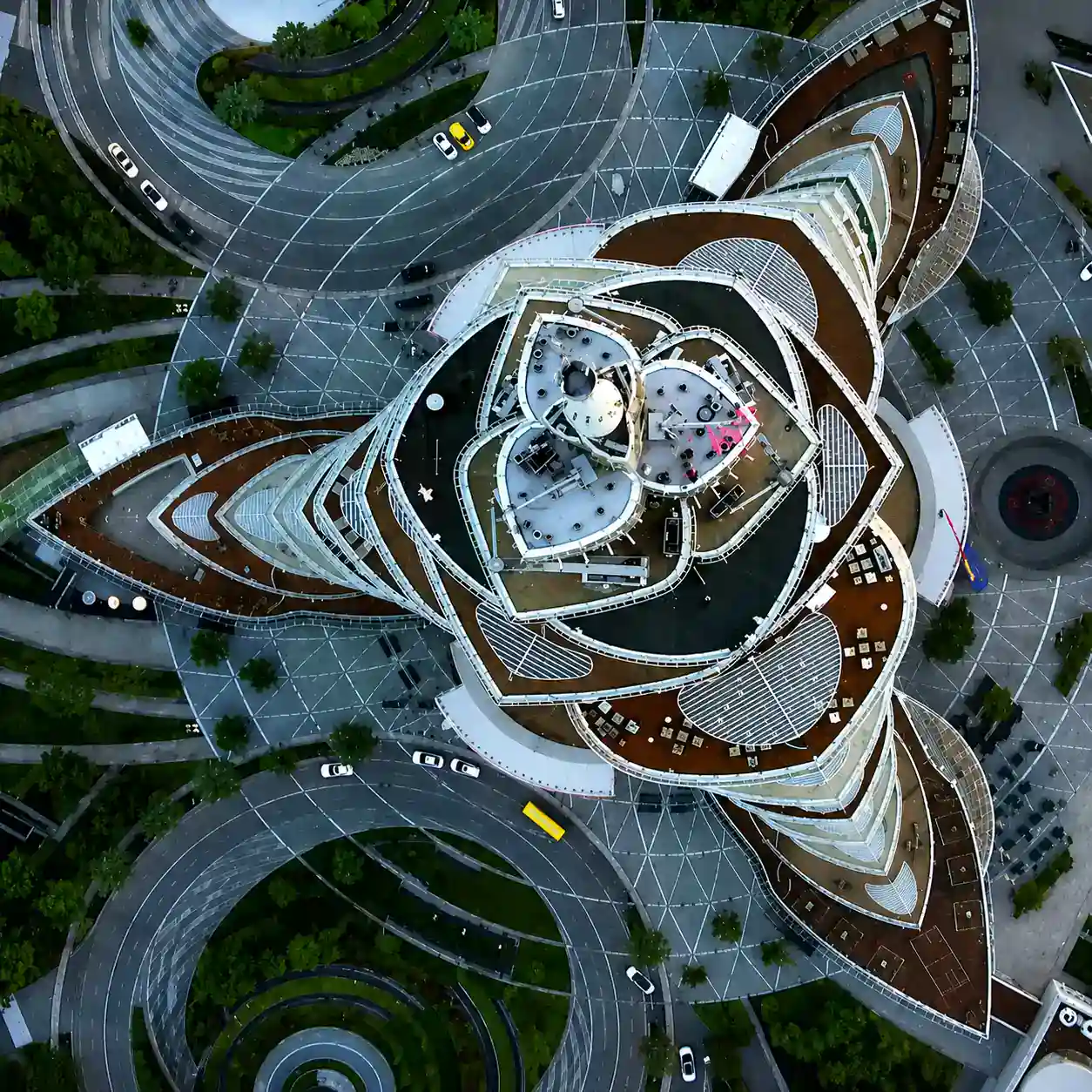
This layout, known as the buttressed core system, was invented by SOM structural engineer Bill Baker specifically for this project. According to the Skyscraper Museum, it remains one of the most significant structural innovations in tall building history.
Here’s how it works in plain terms.
The central core acts like a stiff axle running up the full height of the building. But on its own, that core couldn’t hold a tower this tall upright against the wind. The three wings brace it, with each wing reinforcing the other two, similar to how flying buttresses hold up the walls of a Gothic cathedral.
Baker has described this as each wing helping to “stretch out” the wind pressure toward the base rather than letting it concentrate at any single point.
The Y-shape also solves a practical problem most people never think about. As the building gets narrower near the top, the wings simply taper and end. Columns stop where the floor ends. No expensive steel transfer beams are needed, which are a major cost item in other supertall buildings where floor plates shrink as you go up.
And as a bonus, almost every apartment and hotel room gets a window facing outward toward the Arabian Gulf, which was a major selling point for a building with 900 residential units.
How the Tower Literally Tricks the Wind
This is where it gets interesting, When a tall building has the same cross-section all the way up, like a plain rectangular tower, wind hits it the same way at every level. The vortices that peel off the sides start to sync up. As they synchronize, they push the building sideways in a rhythmic pattern. At extreme heights, this can cause dangerous swaying and in worst cases, structural damage.
The technical name for this is vortex shedding, and it was the SOM team’s biggest concern from day one.
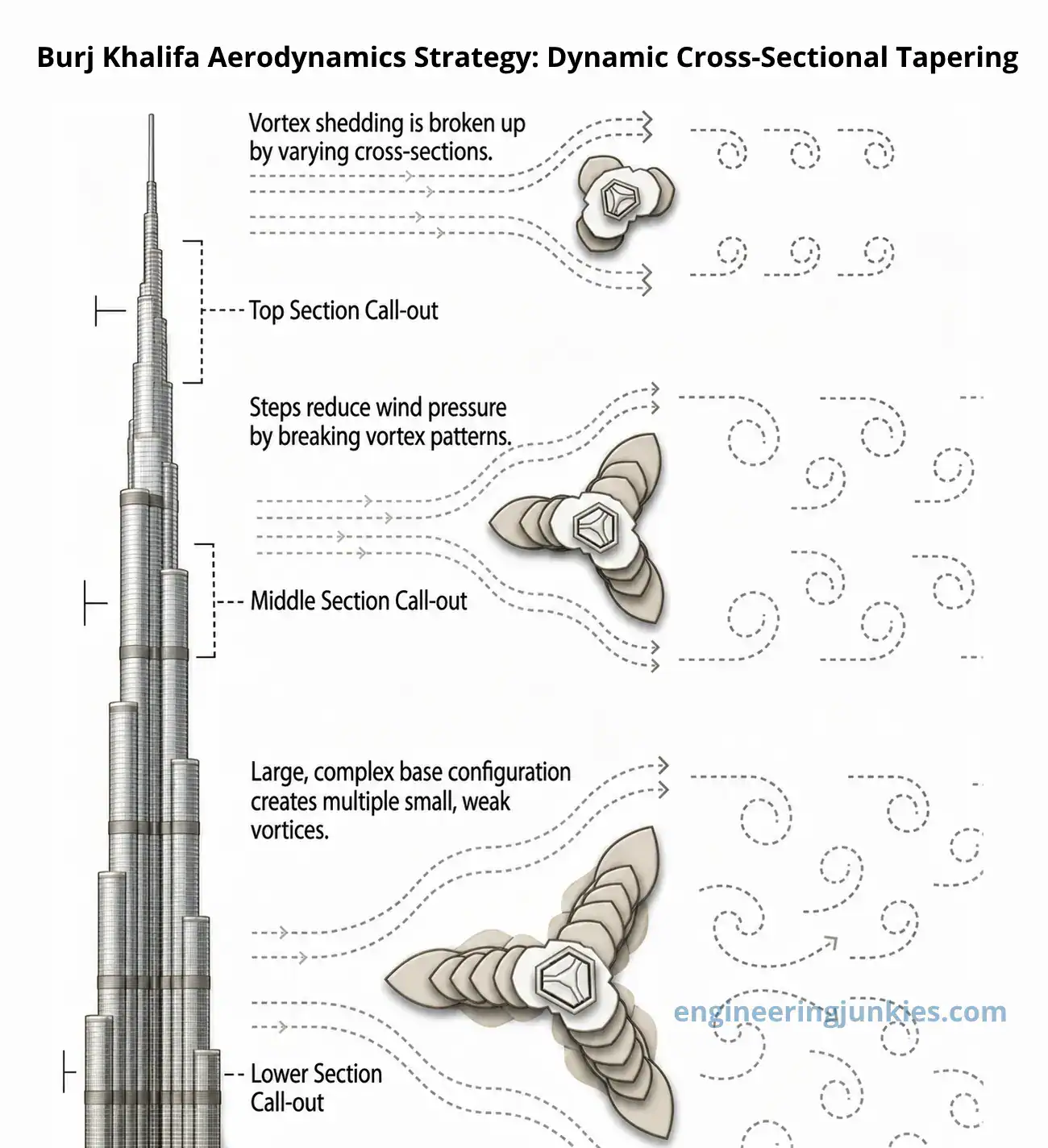
The Burj Khalifa’s solution was elegant. As the building rises, each of the three wings steps back in a spiral pattern, so the cross-section changes at almost every level. Wind engineer Peter Irwin and his team determined that this constantly changing profile prevents vortices from ever organizing into a unified force.
SOM’s own documentation describes the goal as designing the building to “confuse the wind,” a phrase that has since become well known in engineering circles.
More than 40 wind tunnel tests were run at 1:500 scale before the shape was finalized according to the Burj Khalifa official website.. After each test, engineers analyzed the data, reshaped the model, and ran it again. The number and spacing of setbacks changed. The curves on the wing edges were softened. And critically, the direction of the spiral was reversed based on wind data specific to Dubai’s prevailing wind patterns.
That last point matters more than most people realize. The final twist direction of the building was decided by wind data, not by an architect’s sketch.
The Discovery That Made the Burj Khalifa Even Taller
Bill Baker, the structural engineer who led this project, has spoken openly about what happened when the team started running tests on the original 518-meter design.
“Imagine if the original design worked at 518 meters, we might have stopped there,” Baker told Khaleej Times. “But the need for refinement allowed us to grow by 310 meters, a height equivalent to the Eiffel Tower.”
In other words, trying to solve the wind problem at 518 meters led the team to discover they could go much higher. Not despite the wind engineering, but because of it. A better aerodynamic shape reduced overall wind forces enough that extending the height became structurally feasible without proportionally increasing cost or risk.
The result, Baker has said, is a building that is “very quiet” compared to others of its size, as he explained in an interview with New Atlas.
A Flower, a Mosque, and 1,400 Years of Islamic Design
The engineering explains why the shape works. The cultural story explains why it looks the way it does.
The triple-lobed base of the tower was directly inspired by the Hymenocallis, also called the Spider Lily, a desert flower native to the region. According to SOM and confirmed by GoConstruct’s official project documentation, the Y-shaped wings were intended to replicate the petal structure of this flower.
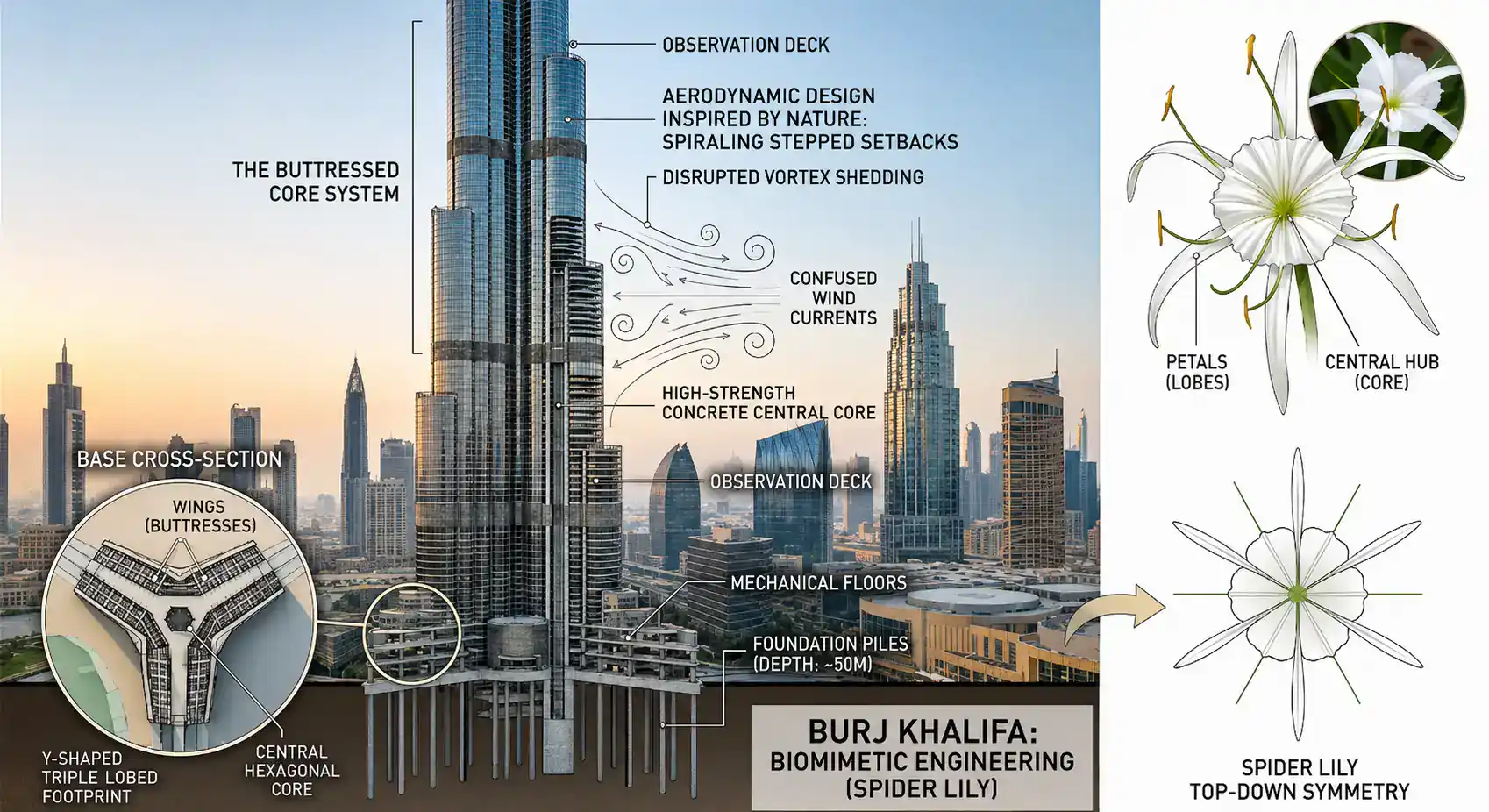
The tower’s overall form also draws from Islamic architecture, specifically the spiral minarets found in historic mosques, most notably the Great Mosque of Samarra in Iraq. The cross-section of the tower decreasing as it rises upward echoes the design of those ancient minarets almost exactly.
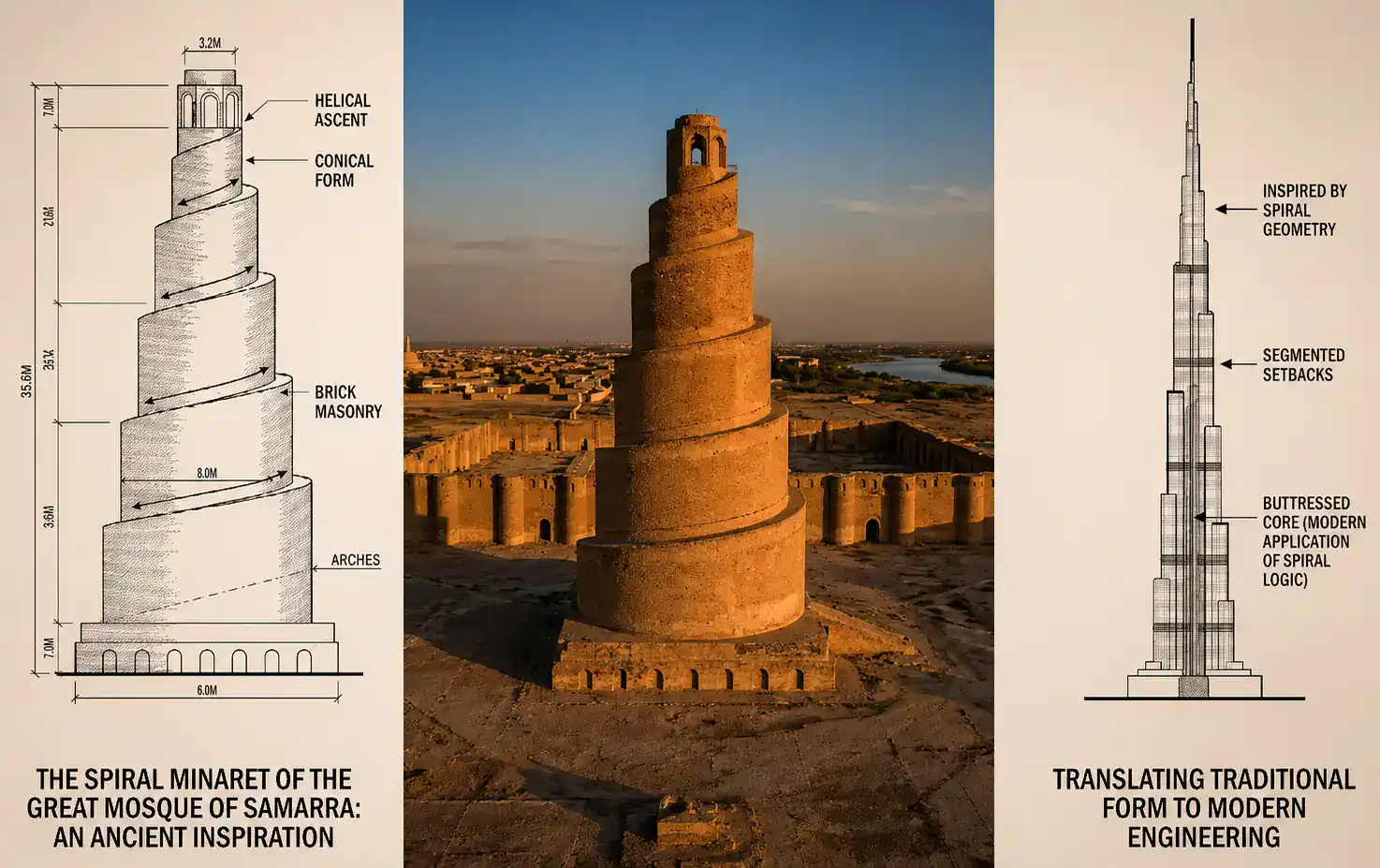
When you look at the Burj Khalifa from ground level or from the air, it reads as a modern building. But the geometry underneath it is 1,400 years old.
This is what separates it from most other “tallest building” projects, which tend to be generic glass boxes stretched upward. The Burj Khalifa is a wind-engineering solution that also happens to be deeply rooted in the culture and history of where it was built.
The Mind-Blowing Numbers Behind the Burj Khalifa
The shape is impressive. What it took to build it is staggering.
According to Gulf News and confirmed across multiple engineering sources, the final construction used:
- 330,000 cubic meters of concrete, roughly the weight of 100,000 elephants
- 39,000 tonnes of steel rebar throughout the structure
- 103,000 square meters of glass across the facade
- 15,500 square meters of embossed stainless steel cladding
- 192 reinforced concrete piles in the foundation, each 1.5 meters wide and buried more than 50 meters underground
The foundation alone required 45,000 cubic meters of concrete weighing over 110,000 tonnes, all poured in the desert heat.
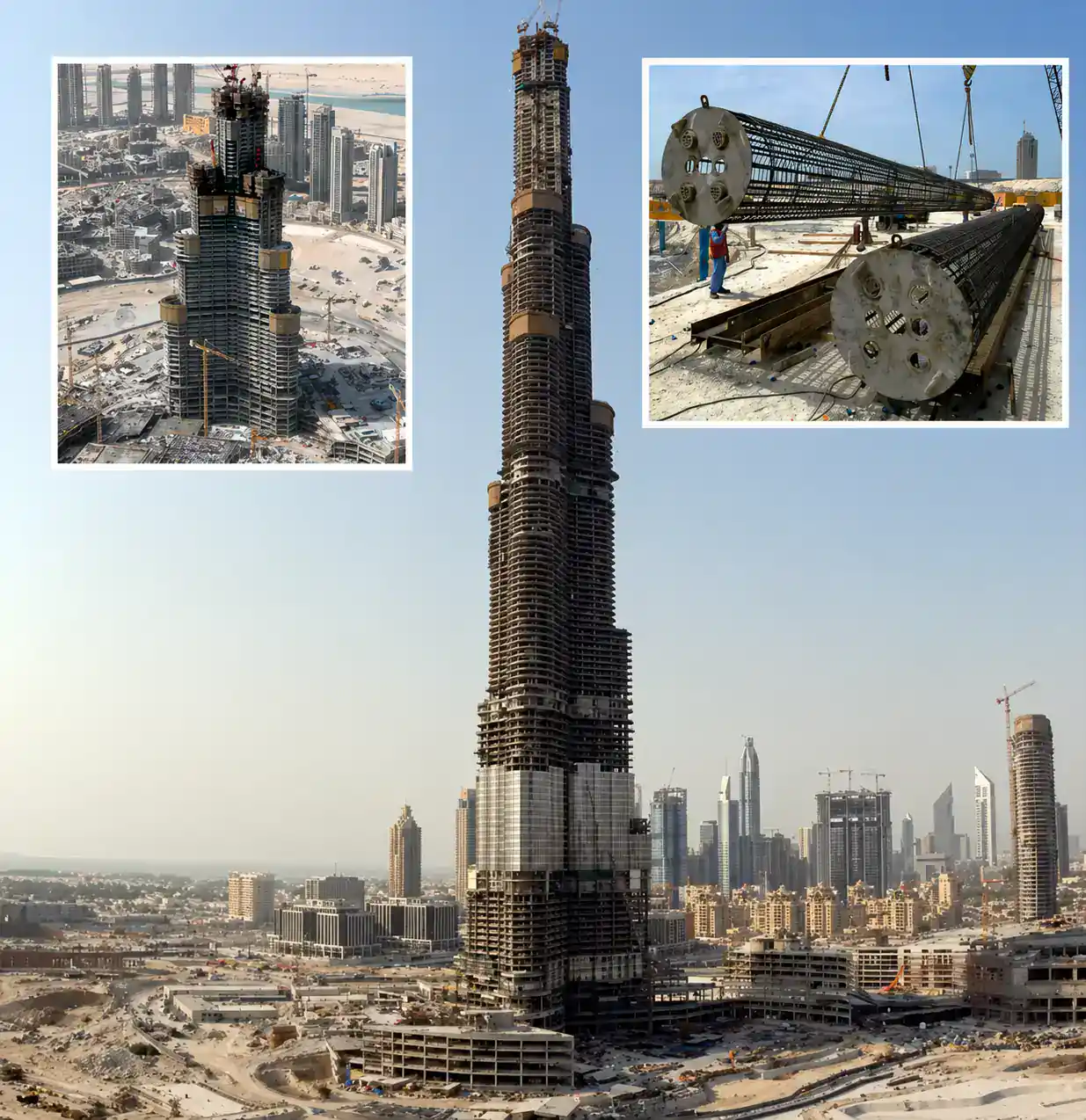
Because concrete cracks when it cures too hot, engineers added ice to the mix and poured it exclusively at night. The concrete had to be specially formulated to handle Dubai’s extreme summer temperatures, which regularly exceed 50°C at ground level, while the upper floors sit in much cooler, faster-moving air.
Concrete was pumped up to 606 meters, reaching the 156th floor and setting a world record for concrete pumping height at the time. Above floor 156, the structure transitions to a lighter structural steel frame, which is how the spire was built without adding prohibitive weight at the top.
The total construction took 22 million man-hours across six years, involving over 12,000 workers from more than 100 countries, at a construction cost of approximately $1.5 billion.
Why the Top of the Burj Khalifa Looks So Different
As the three wings spiral upward and step back, they gradually give way to the central hexagonal core, which continues climbing on its own and tapers into the building’s finishing spire.
That spire is a hollow steel structure over 110 meters tall, assembled in more than 20 welded sections inside the building as construction progressed upward. It was then hydraulically jacked into its final position in eight separate lift cycles using strand jacks and roller guides threaded through temporary gaps in the structure.
The stainless steel fins visible on the exposed portion of the spire aren’t decoration. They continue the spiral geometry of the building and help manage airflow right at the tip, where the wind is fastest and most unpredictable.
One thing worth knowing: the highest occupied floor sits at around 585 meters. The remaining 243 meters above that, roughly 30% of the total height, exists purely to secure the world-record height. Nobody lives or works up there. It is, in the most literal sense, an architectural statement.
How the Burj Khalifa Beats Other Super Tall Towers
The Burj Khalifa’s approach was genuinely different from how earlier supertall buildings handled wind.
Taipei 101 in Taiwan, which held the height record before the Burj Khalifa at 508 meters, used a massive 660-tonne steel pendulum inside the building called a tuned mass damper to absorb wind-induced swaying after the fact. It’s an effective system, but it adds enormous weight and cost.
The Burj Khalifa doesn’t use a tuned mass damper. Instead, the shape itself handles the wind before it becomes a structural problem. According to SOM’s project documentation, the buttressed core and spiral setbacks reduce wind forces enough that an active damping system simply wasn’t needed.
The Shanghai Tower in China, completed in 2015 and now the second-tallest building in the world at 632 meters, borrowed directly from the Burj Khalifa’s approach by using a twisted, tapering form to reduce wind loads by around 24% compared to a straight tower. The influence of Baker’s buttressed core concept on subsequent supertall designs has been widely acknowledged in engineering literature.
Common Questions About the Burj Khalifa’s Shape
⌄
⌄
⌄
⌄
⌄
⌄
⌄
⌄
Written by
Engineering Junkies Team
We are a team of engineers, researchers and technology writers who love breaking down complex topics into clear and honest content. Every article we publish is built on real research and honest writing.
You can reach us through our Contact Us page.