
Imagine waking up, putting on one dress, and wearing ten different outfits throughout the day.
No changing rooms. No extra clothes. Just a tap on your phone.
That is not a dream anymore. Adobe built it. They call it Project Primrose.
What Is Project Primrose?
It is a dress that changes its own design in real time.
One second it is plain silver. The next it has flowing patterns moving across the fabric. Press a button and it changes again.
Adobe showed it to the world at the Adobe MAX 2023 conference in Los Angeles. The crowd went completely silent when they saw it. Then they went wild.
A video of the moment got over 10 million views on TikTok.

How Does It Actually Work?
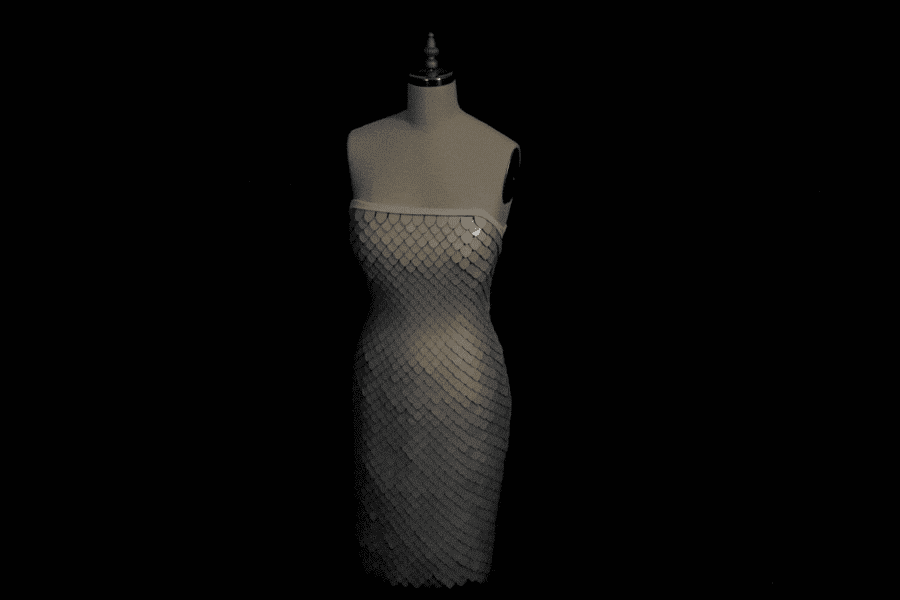
Think of the dress as covered in tiny smart tiles.
Each tile is made from a material called PDLC which stands for polymer dispersed liquid crystal. It is the same material used in those smart glass windows that go frosted when you flip a switch.
When electricity runs through the tile it changes how it reflects light. That makes the tile look different. Put 1,182 of those tiles together on a dress and you get something that can shift its entire appearance in seconds.
Here is why it is clever. The tiles do not produce their own light like a screen does. They reflect the light around them. That means they work great in bright places and they use very little battery power.
The patterns are designed using Adobe software you may already know. Illustrator for still designs. After Effects for moving animations. Once a design is ready it gets loaded onto the dress and plays back like a short video on loop.
The dress connects to a phone via Bluetooth. You can switch designs on the spot or set it to change automatically.

It Already Walked the Runway
After the viral debut at Adobe MAX the dress was still a research prototype. Fashion designer Christian Cowan saw the video and got in touch immediately.
In under two months Adobe and Cowan’s team built the first fully complete version of the dress.
On February 11 2024 it walked the runway at New York Fashion Week as the main look of Cowan’s Fall/Winter 2024 show.
This version covered the entire dress front to back. The original only covered the front panel. Cowan swapped the hexagon shaped tiles for his signature star shapes. The finished piece had 1,264 hand-cut tiles and 14 larger star pieces on the skirt.
It was still silver and ivory because the technology currently works in grayscale. But the effect on the runway stopped the show.
This Idea Is 10 Years Old
Most people think Project Primrose came out of nowhere in 2023. It did not.
The idea started in 2013 as a concept for a sweater that could change based on the weather.
In 2017 Adobe built Project Glasswing which was a display box that could show animations in front of objects placed inside it.
The formal research paper was published in 2022. It was presented at a major technology conference using a canvas and a handbag as demo pieces.
The dress that shocked the world in 2023 was built on 10 years of quiet work.
Where Else Could This Go?
The dress is just the beginning.
Adobe is looking at using this technology for furniture. Cushions and curtains that change color with the season. Wall panels that update like a screensaver.
There are also practical uses outside the home. Military clothing where camouflage patterns adapt automatically. Advertising surfaces built into fabric. Retail displays that change without printing new materials.
The PDLC material can be cut into any shape. That means it could go on almost any surface not just clothing.

Can You Buy It Yet?
Not yet.
Project Primrose is still a research project. Adobe has not announced a price or a release date for a consumer version.
There are still real challenges to solve. Adding full color is the biggest one. Right now the technology only works in shades of gray and silver. Weight is another issue. The circuit boards and battery packs add bulk that you would not want in everyday wear.
But the pace of progress has been fast. A handbag demo in 2022 became a runway dress in 2024. Things are moving quickly.
Who Made It?
Her name is Christine Dierk.
She is a research scientist at Adobe who specializes in wearable technology. She did not just design the dress. She built it with her own hands and then wore it on stage.
She started the project as an intern in 2019. Her goal was to finish a working prototype in one summer.
It took four years.
She taught herself to sew by watching YouTube videos. Then she brought that skill into the Adobe lab and stitched over 1,000 petals onto the dress by hand.
Her colleague TJ Rhodes worked alongside her on the electronics. Together they turned a summer intern project into one of the most talked about technology reveals in recent memory.