Quick Answer
Every AI query generates heat. That heat gets removed with water. In 2025, AI data centers used 264 billion gallons of it globally. That’s 550 million gallons every single day. And the number is climbing fast.
Key Takeaways
- AI data centers consumed nearly 264 billion gallons of water in 2025, according to
Mordor Intelligence. - A single NVIDIA H100 GPU draws up to 700 watts. Data centers run tens of thousands of them, nonstop.
- Cooling towers use water to remove heat, and about 80% of that water is lost into the air as evaporation. Homes lose just 10%.
- Training GPT-3 directly evaporated 700,000 liters of clean freshwater in Microsoft’s U.S. data centers.
- About two-thirds of new U.S. data centers since 2022 have been built in water-stressed regions.
- Microsoft launched a zero-water cooling design in August 2024. Google has pledged water-positive by 2030.
- By 2030, global data center water use could exceed 1.2 trillion liters per year.
Why Does AI Use So Much Water?
When you ask ChatGPT a question, the answer does not appear by magic. Behind the scenes, powerful computers inside data centers process your request in seconds.
These computers work very hard and produce a lot of heat. If they get too hot, they can slow down or even stop working properly. To prevent that, data centers use cooling systems to remove the heat.

Many of these cooling systems rely on water. As the water absorbs heat, some of it evaporates into the air. That means every AI request uses a small amount of water somewhere in the process.
A single question does not use much water on its own. The challenge comes from scale. Millions of people use AI tools every day, generating billions of requests. When all of those requests are added together, the amount of water used becomes enormous.
Most people never see this hidden cost. They only see the answer on their screen. But every AI response requires electricity, computing power, and often water to keep the systems running.
Why Do AI Servers Get So Hot?
The chips that power AI are not like ordinary processors. A regular laptop CPU might draw 15 to 45 watts. NVIDIA’s H100 GPU, one of the most widely used AI chips in data centers today, draws up to 700 watts per unit.
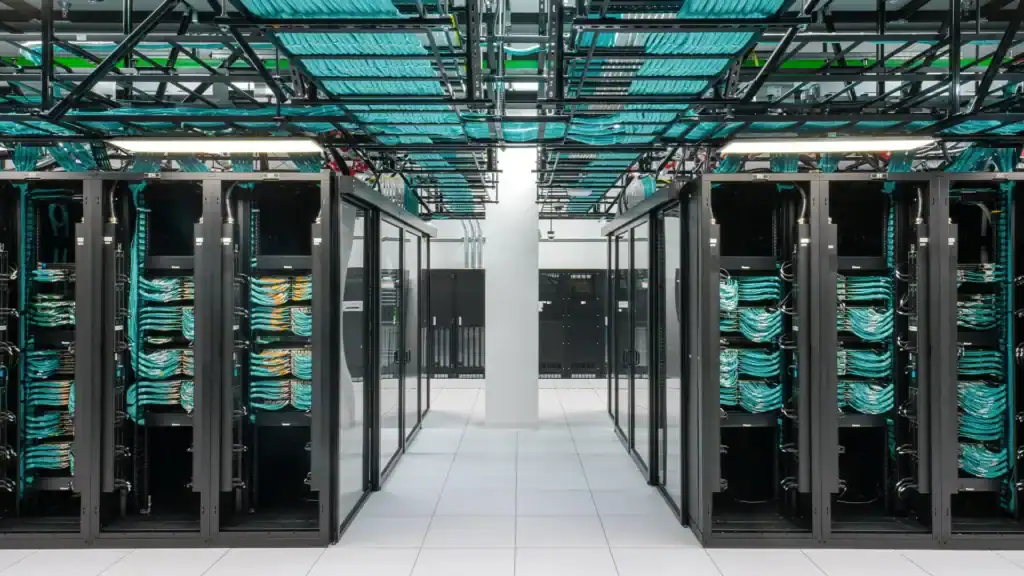
That’s roughly seven desktop computers worth of heat, from a single chip.
And data centers don’t house one chip. They house tens of thousands of them, running around the clock, seven days a week.
The rack math
A single NVIDIA DGX H100 server holds eight H100 GPUs and pulls around 10.2 kilowatts under full load. NVIDIA’s newer GB200 NVL72 rack system packs in 72 Blackwell-generation chips and demands up to 140 kilowatts per rack. Back in 2022, a typical server rack averaged around 25 kilowatts. Modern AI servers use about five times more power than typical server racks from just a few years ago.
Old data centers handled email and basic web traffic. Air cooling was fine. Cold air flowed through the aisles, absorbed heat, and got vented out. Simple enough.
AI broke that model entirely. The heat output at modern GPU densities is comparable to a steel mill. Air just cannot move enough thermal energy fast enough. That’s where water comes in.
Also Read: Why AI Data Centers Use So Much Electricity?
How AI Data Centers Use Water for Cooling
Evaporative Cooling Towers: The Biggest Source of Water Loss
This is the most common cooling method, and also the one that uses the most water. It works like sweating. When water evaporates, it takes heat away with it.
Hot air from servers passes through wet cooling pads. The water evaporates and removes heat from the air. The cooled air then goes back to the servers. This cycle keeps repeating nonstop.
The downside is that a large amount of water is lost. Around 80% of the water turns into vapor and disappears into the air, according to Professor Shaolei Ren at UC Riverside. It does not return to the local water system. In comparison, a household returns about 90% of its water back into the supply after use. That makes data centers much more water-intensive.
There is another issue too. Minerals like calcium, chloride, and silica build up in the cooling water. Because of this, the water can only be reused about 3 to 10 times before it has to be drained and replaced. So even more fresh water is needed constantly.
Closed-Loop Cooling Systems: Using Less Water
These systems use two separate water loops connected by a heat exchanger.
One loop runs cold water through the servers and picks up heat. The second loop carries that heat to a cooling unit, releases it into the air, then sends the cooled water back again.
It’s more efficient and wastes less water, but it still isn’t perfect. The outer loop often uses evaporation, so some water is still lost.
Direct-to-Chip and Immersion Cooling Explained
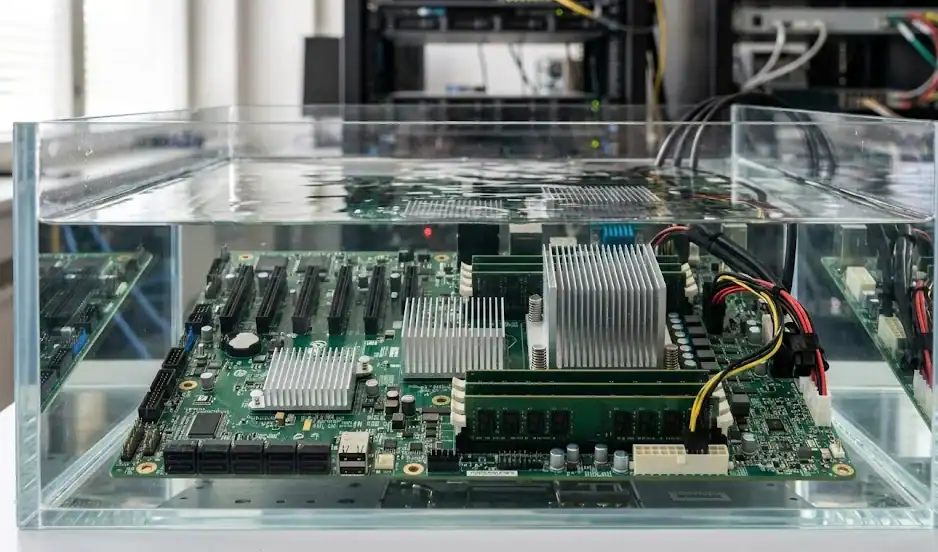
In direct-to-chip cooling, metal plates sit right on top of the processors. Cool liquid flows through them and removes heat at the source before it spreads. The warmed liquid then goes to a heat exchanger and can be cooled again without needing evaporation.
Immersion cooling goes even further. Entire servers are placed inside special non-conductive liquid. It absorbs heat directly and keeps the hardware cool without air or evaporation.
This shift is already happening at the highest levels. NVIDIA’s Blackwell chips, released in 2025, are built for full liquid cooling. It’s a clear sign that traditional air cooling is reaching its limits.
Training AI vs Using AI: Which Uses More Water?
How Much Water Does It Take to Train an AI Model?
Training a large AI model means feeding it huge amounts of data and adjusting billions of internal settings over weeks or even months of nonstop GPU work. This creates a huge amount of heat that must be cooled.
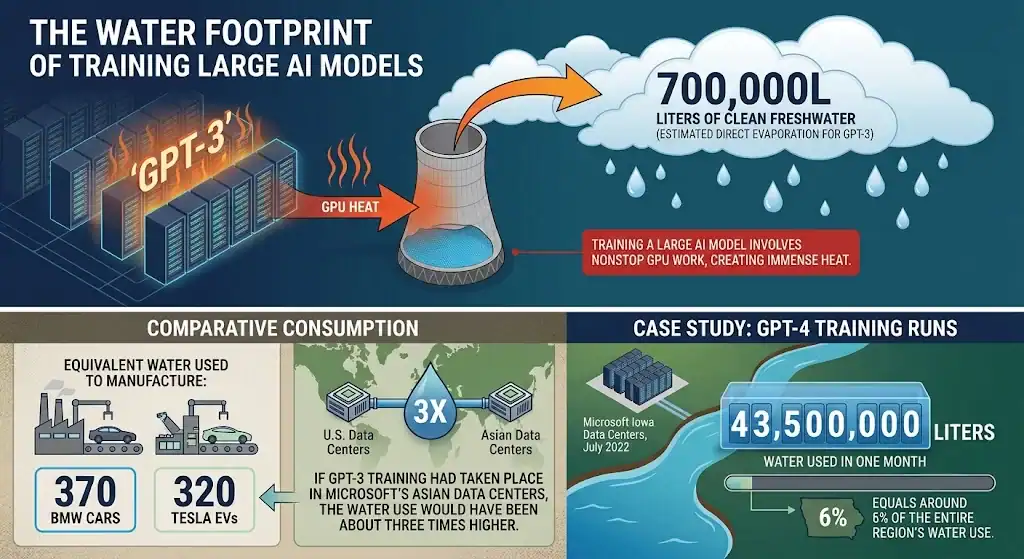
Researchers at UC Riverside estimated that training GPT-3 in Microsoft’s U.S. data centers directly caused the evaporation of about 700,000 liters of clean freshwater. That’s roughly the same amount of water used to manufacture 370 BMW cars or 320 Tesla electric vehicles.
If that same training had taken place in Microsoft’s Asian data centers, the water use would have been about three times higher.
In July 2022, during GPT-4 training runs at Microsoft’s Iowa data centers, those facilities used about 43.5 million liters of water in just one month. That was around 6% of the entire region’s water use for that time period.
How Much Water Does ChatGPT Use Every Day?
After training, the ongoing cost is called inference. This is what happens every time you send a message to an AI chatbot. Your request is processed instantly in a data center. One message uses a very small amount of resources, but when millions of people use it every day, the total adds up quickly.
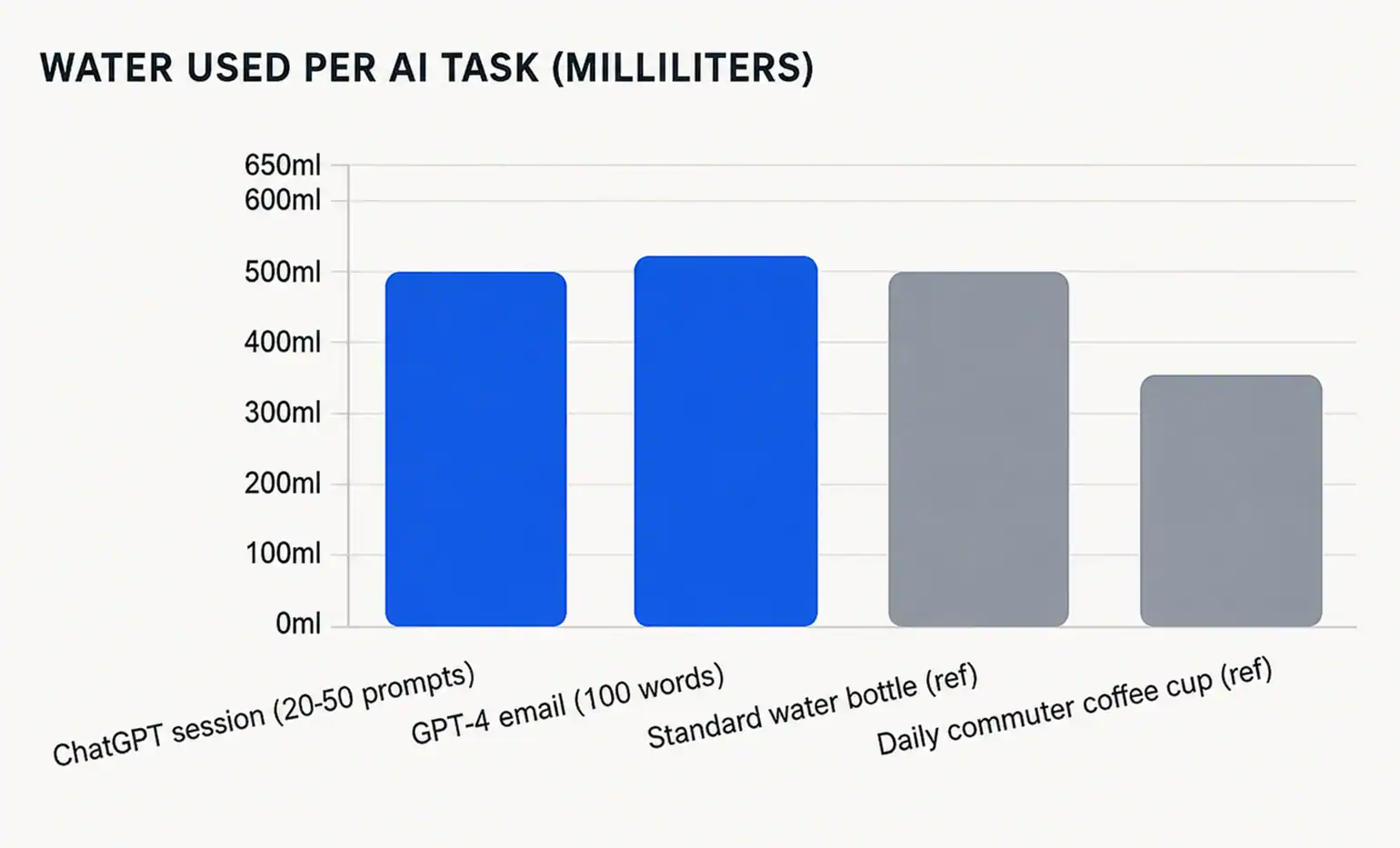
Researchers at UC Riverside estimate that ChatGPT uses about 500 milliliters of water, about the size of a standard water bottle, for a session of roughly 20 to 50 prompts.
A separate 2024 analysis by The Washington Post and Professor Shaolei Ren found that generating a 100 word GPT 4 email uses around 519 milliliters of water when water use from electricity production is also included.
To understand the full scale, imagine this. If just one in ten working Americans used ChatGPT once a week to write a short email for an entire year, the total water used from that single habit would be about 435 million liters. That is roughly the same amount of water all households in Rhode Island use in about a day and a half.
GPT-5, which launched in August 2025, is estimated to use about 55 times more energy per prompt than GPT-4o. Since energy use and water use are closely linked, higher energy use also means higher water use.
Which Tech Companies Consume the Most Water for AI?
Some companies publish their numbers. Many don’t. Here’s what’s publicly known.
| Company | Annual water use | Notable detail |
|---|---|---|
| 6.1 billion gallons (2024) | Up from 4.3B gallons in 2021. One Iowa facility alone used 1 billion gallons in 2024. | |
| Microsoft | Not fully disclosed | Iowa data centers used 43.5M liters in one month during GPT-4 training. 42% sourced from water-stressed areas (2023). |
| Meta | Not fully disclosed | Single Newton County, Georgia facility uses 500,000 gallons per day — roughly 10% of the county’s entire supply. |
| Equinix | 1.2 billion gallons (2024) | Withdrew 1.4B gallons total; consumed 85% of that. |
| U.S. data centers (all) | ~17 billion gallons direct (2023) | Lawrence Berkeley Lab projects 38 to 73 billion gallons annually by 2028. |
Sources: MOST Policy Initiative, WaterVerge, Sentinel Earth, Environmental Law Institute.
Transparency is a real issue here. Many companies treat water usage as private or proprietary information. In many cases, local utilities also refuse to share water consumption data for individual customers.
Google even went to court to block an Oregon newspaper from accessing how much water its data center was using there, arguing that the information was a trade secret.
This shows how limited public access is to basic information about water use, and raises questions about how much accountability there really is on this issue.
Building Data Centers in the Wrong Places
Where a data center is built makes a big difference in how much water it needs. Cooler and wetter places need less evaporative cooling. But developers often choose locations with cheaper land, lower taxes, and easier regulations, even if those areas are very dry.
According to the World Resources Institute, about two thirds of U.S. data centers built or planned since 2022 are in water stressed areas, including southern Arizona, the Colorado River Basin, and Texas. Around 40% of all existing and planned facilities are in regions facing high or extremely high water stress.
Texas alone used about 49 billion gallons of water for data centers in 2025. By 2030, projections from the Houston Advanced Research Center estimate this could rise to up to 399 billion gallons per year, which is about 6.6% of the state’s total water use.
The drought paradox
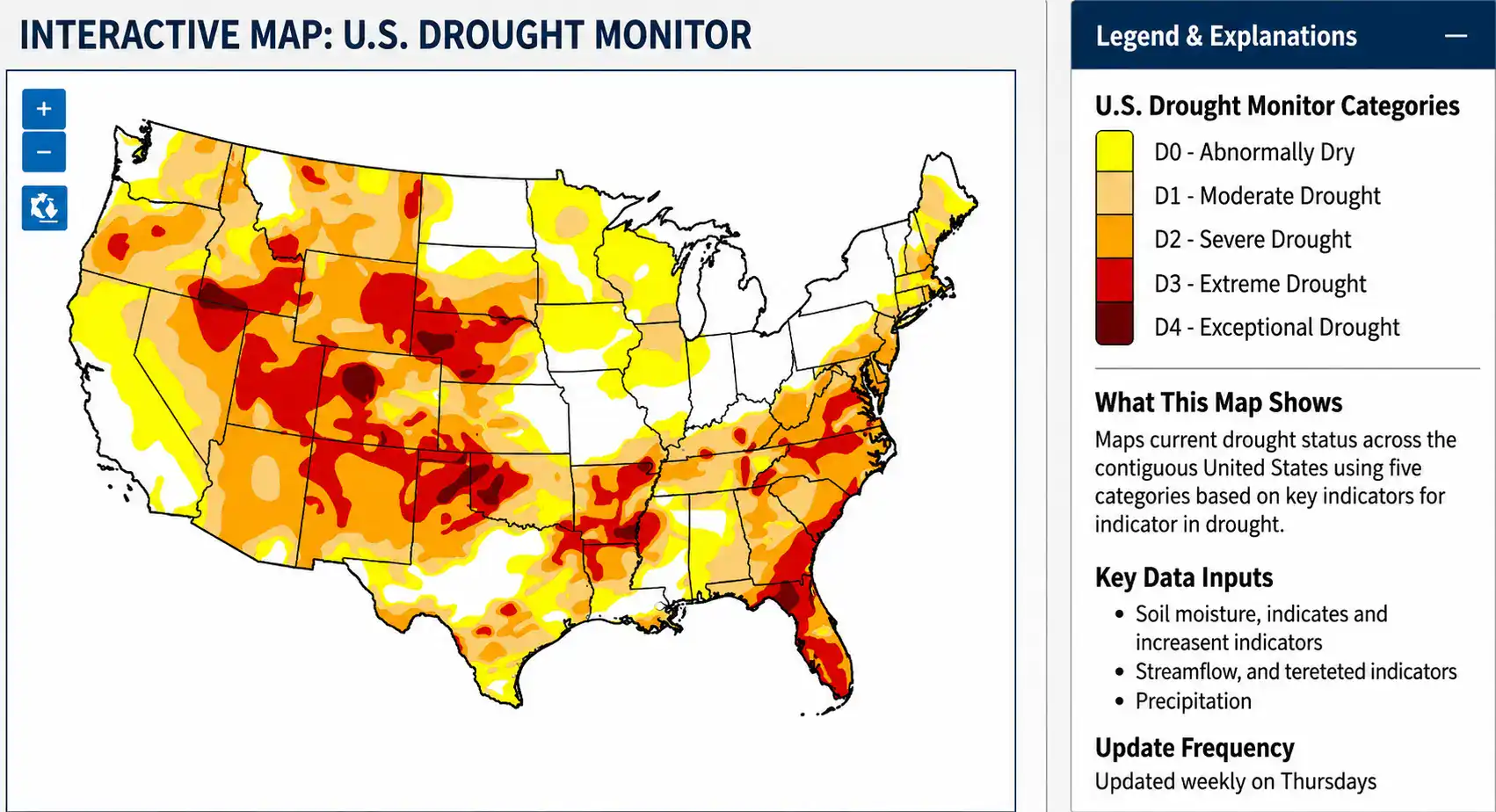
In June 2026, nearly 63% of the United States is in drought conditions, according to the U.S. Drought Monitor. Large portions of the Southeast, Midwest, Southwest, and West are affected. AI data center water consumption is hitting record highs in many of these same regions simultaneously.
In August 2025, the Tucson city council unanimously rejected an Amazon linked data center project due to water concerns. In South Carolina, residents living near an overdrawn aquifer have pushed for limits on groundwater use by data centers.
These are not isolated cases. Communities are increasingly pushing back, and in some cases, they are succeeding.
The Hidden Water Cost of AI
Power Plants Use Water Too
Most power plants, including coal, gas, and nuclear, rely on water to cool turbines and condensers. So when a data center uses electricity from the grid, it is also indirectly responsible for the water used in power generation.
The Environmental Law Institute estimates that in 2023, data centers’ indirect water use from electricity production reached about 211 billion gallons, averaging roughly 1.2 gallons per kilowatt hour.
This is also why different studies show very different water numbers per AI request. The estimate of 519 milliliters for a GPT 4 email includes indirect water from electricity use. OpenAI’s internal figure of 0.3 milliliters per query only counts direct on site water use. Both are correct, but they measure different things.
How AI Chip Manufacturing Consumes Water
Making an AI chip also requires a lot of ultrapure water. It takes about 2.1 to 2.6 gallons of water per chip, just to cool equipment and keep wafer surfaces free from contamination. A modern data center can use tens of thousands of chips.
This upstream water use is usually not included in corporate sustainability reports. The water is already consumed long before the data center even processes its first AI query.
How AI Data Centers Impact Local Communities
The impact becomes very real when you look at individual towns.
In Newton County, Georgia, one Meta data center uses about 500,000 gallons of water per day. That single facility accounts for roughly 10% of the county’s total water supply.
Large data centers can use as much water as towns with 10,000 to 50,000 people. In Iowa, one facility used about 1 billion gallons in 2024, which is enough to cover the state’s residential water needs for five days.
Water quality can also be affected. The water that is returned from cooling systems often contains higher levels of calcium, chloride, and silica. This can change the taste of drinking water, reduce crop yields, and lower oxygen levels in rivers and streams. When this water is discharged, it is also warmer than natural water, which can harm aquatic life.
There is also a public health concern. Legionella bacteria, which can cause Legionnaires’ disease in humans, can grow in poorly maintained cooling towers and spread through released water vapor.
The economic benefits for local communities are also more limited than often claimed. According to Consumer Reports, while data centers do create construction jobs, a study by the nonprofit Food and Water Watch found that only about 23,000 people were employed in the entire U.S. data center industry at the end of 2024.
A research study published in November 2025 also found no clear evidence that data centers lead to local growth in tech employment.
What Companies Are Actually Doing About It
Microsoft’s Zero-Water Data Center Cooling System
In August 2024, Microsoft introduced a new data center design that uses zero water for cooling. It uses direct to chip liquid cooling in a sealed closed loop system that does not evaporate water. Heat is removed using dry coolers instead of evaporation.
The company estimates that each facility using this design will prevent more than 125 million liters of evaporated water per year. The first pilot sites are in Phoenix, Arizona and Mount Pleasant, Wisconsin. Since August 2024, all new Microsoft data center designs have used this system.
Google’s Plan to Become Water Positive by 2030
Google has pledged to become fully water positive by 2030, meaning it plans to return more fresh water to local ecosystems than its data centers consume worldwide.
It is investing 500 million dollars in public water infrastructure and watershed projects. More than 25 percent of its data center campuses already use reclaimed wastewater or other non drinking water sources.
However, critics point out limits to water offsetting. Restoring water in one region does not help communities that are losing water locally. As Villanova University researcher Wemhoff said, carbon is a global problem, water is more localized. Offsets can work for carbon, but they do not fully solve water issues.
Oracle’s Water-Saving Cooling Strategy
Oracle has shifted its newest AI data centers in New Mexico, Michigan, Wisconsin, and Texas to direct to chip, closed loop, non evaporative cooling. The system works like a car radiator. Coolant flows through the system, absorbs heat, releases it through a radiator into the air, and then circulates again. There is no evaporation and almost no daily water use required.
Recycled Water and New Data Center Regulations
AWS now runs some of its Virginia facilities on 100 percent recycled water. After Mesa, Arizona council member Jenn Duff said she did not think water cooled data centers belonged in the desert, Google changed a planned Mesa facility from water spray cooling to air cooling.
In 2025, Texas passed legislation that allocated billions of dollars for water infrastructure. Virginia lawmakers have also pushed for rules requiring water use disclosure as part of data center permits. Between May 2024 and March 2025, more than 64 billion dollars in data center projects were delayed or canceled due to community opposition.
Will AI Use Even More Water in the Future?
The International Energy Agency estimates that all data centers together used about 560 billion liters of water in 2023. By 2030, this is expected to rise to more than 1.2 trillion liters, which is more than London’s total annual residential water use.
Researchers at UC Riverside project that global AI water use could reach 4.2 to 6.6 billion cubic meters by 2027. That is more than the total yearly water use of several small countries combined.
In the United States, Lawrence Berkeley National Laboratory estimates that direct data center water use will increase from about 17 billion gallons today to between 38 and 73 billion gallons by 2028.
The technology to reduce this already exists. Zero water cooling systems can eliminate evaporation. Building data centers in cooler and wetter regions can reduce both water use and carbon emissions.
Using recycled wastewater removes pressure on drinking water supplies. Requiring companies to disclose exact water use at each site would also help communities and regulators manage the impact.
The main issue is not technology. It is policy. Until transparency is required and rules are enforced, companies will likely continue choosing cheaper land over more sustainable practices.
Why Should You Care?
You might never visit a data center, but AI is becoming part of everyday life. Every search, chatbot conversation, and AI-generated image depends on data centers running around the clock.
As AI grows, so does its demand for electricity and water. Understanding that impact helps consumers, businesses, and governments make better decisions about how AI should be developed in the future.
What You Can Do?
- →Check if your ISP, cloud provider, or AI tool publishes a water sustainability report. If they don’t, that absence is the answer.
- →Use the World Resources Institute’s Aqueduct tool to see water stress levels in areas where major data centers operate.
- →If you’re in local government or civic life, push for water use disclosure requirements tied to data center permitting.
- →When choosing between AI tools for work, ask whether the company behind it has made any public commitments on water use.
- →Spread the word. Most people have no idea this tradeoff exists. That lack of awareness is part of what lets it continue.
Final Thought
Somewhere in the American West, right now, a reservoir is lower than it was last year. A farmer is negotiating for less irrigation water. A town is thinking about mandatory restrictions.
And in the same region, a data center is evaporating millions of gallons to keep AI chips from overheating so someone on the other side of the planet can generate a cover letter.
That’s not an argument against AI. It’s an argument for honesty about what AI costs, who pays that cost, and whether the people paying it had any say in the matter.
The technology to build differently exists. The question is whether the industry will be required to use it before the water runs out.
Frequently Asked Questions: AI Data Center Water Use
⌄
⌄
⌄
⌄
⌄
⌄
Written by
Engineering Junkies Team
We are a team of engineers, researchers and technology writers who love breaking down complex topics into clear and honest content. Every article we publish is built on real research and honest writing.
You can reach us through our Contact Us page.