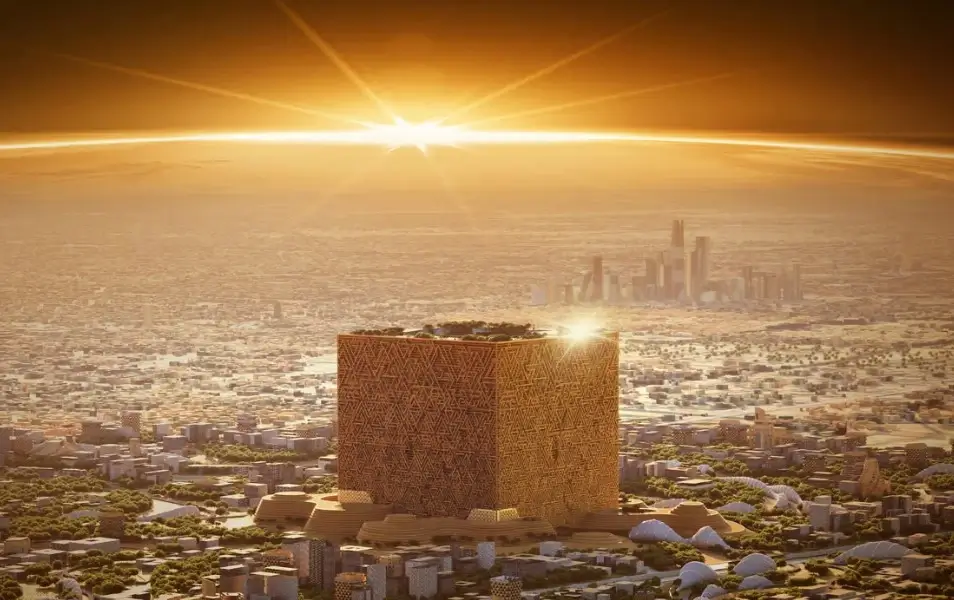
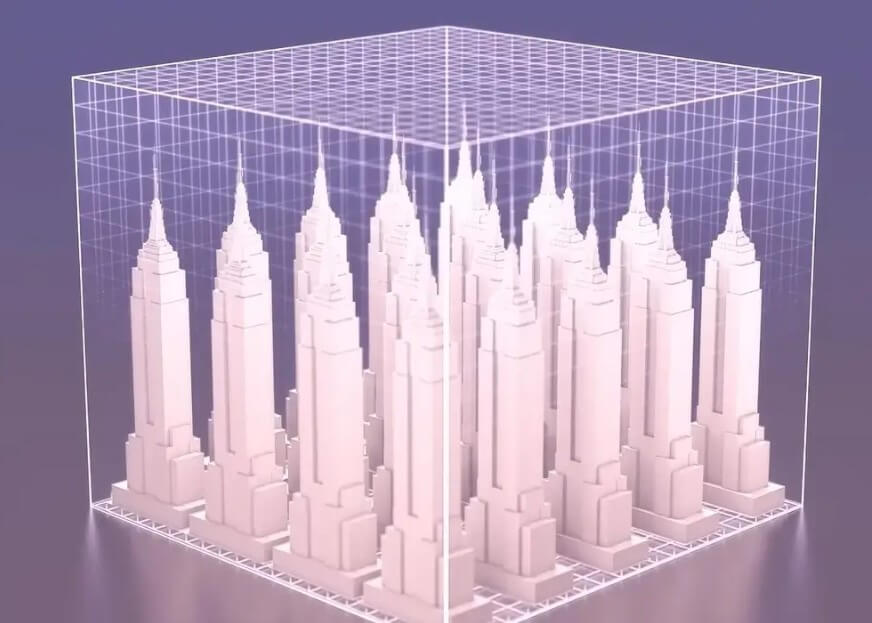
Imagine a building so large it could swallow 20 Empire State Buildings whole. That is what Saudi Arabia set out to build in the heart of Riyadh.
Crown Prince Mohammed bin Salman unveiled the Mukaab in February 2023 as the centrepiece of a massive new development called New Murabba. The name means “cube” in Arabic and the building is exactly that. A perfect cube measuring 400 meters on every side. Height, width and length all the same.
It would be one of the largest structures ever built by human beings.
What Is the Mukaab?
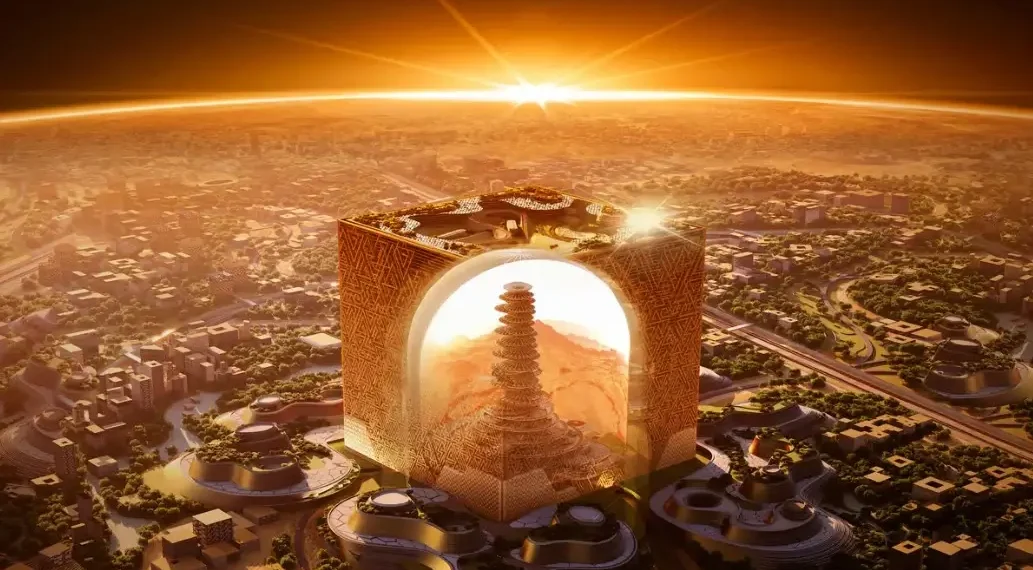
The Mukaab is not a normal skyscraper. It is an entire city compressed into a single giant building.
At 400 meters tall it would rank among the top 41 tallest buildings on Earth. But height is not what makes it remarkable. What sets it apart is the sheer volume of space inside.
The interior spans roughly 2 million square meters of floor area. That figure surpasses even the Boeing Everett Factory in Washington State which currently holds the record as the largest building on Earth by volume.
The exterior draws from the historic Murabba Palace and the modern Najdi architectural style. Traditional geometric patterns meet contemporary glass cladding. From the outside it looks like a mirrored cube hovering over the Riyadh skyline.
What Would Be Inside?
At the centre rises a spiraling tower more than 300 meters tall sitting inside the cube. Picture a skyscraper built inside another skyscraper. Around it would sit an enormous dome powered by artificial intelligence creating what developers called the world’s largest immersive digital experience. The idea was to blur the line between physical and virtual reality at a scale that has never been attempted before.
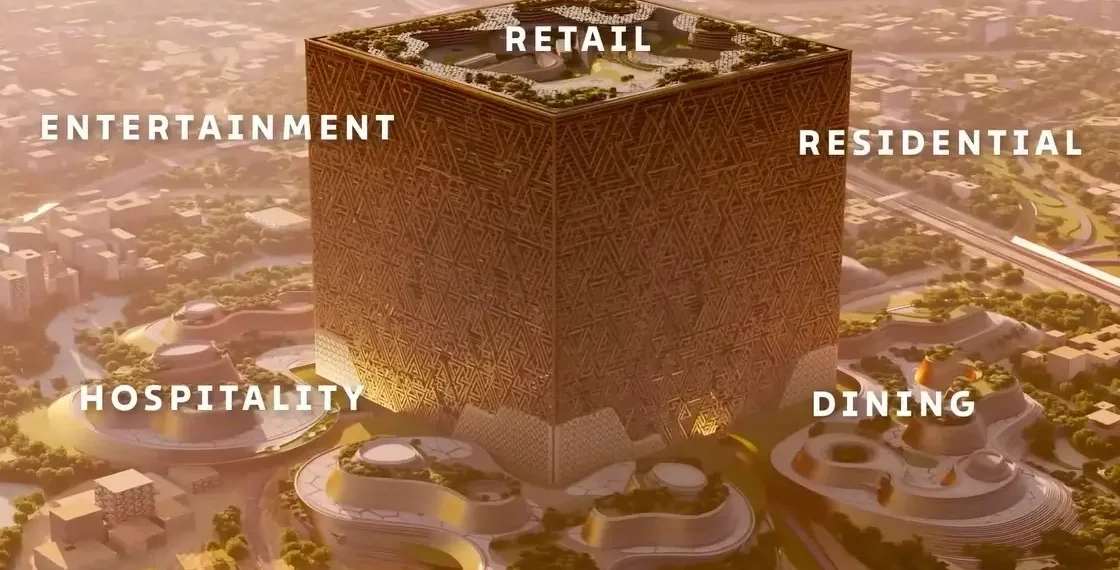
Beyond the spectacle the Mukaab was planned as a fully functioning urban neighbourhood offering:
- 104,000 residential units
- 9,000 hotel rooms
- 980,000 square meters of retail space
- 1.4 million square meters of offices and commercial space
- 620,000 square meters of leisure facilities
- 1.8 million square meters of communal areas
- A museum, a multipurpose theatre and a technology and design university
- More than 80 cultural and leisure outlets
Everything a resident would need would be within a 15-minute walk. The building was also designed with its own internal transport system and sits just 20 minutes from King Khalid International Airport.
A rooftop garden would crown the top. Green walkways and cycling paths were woven throughout the interior to encourage an active lifestyle even inside a building.
Where Is It Located?
The Mukaab sits at the core of the New Murabba district in northwestern Riyadh at the intersection of King Salman Road and King Khalid Road. The wider New Murabba development spans 19 square kilometers making it one of the most ambitious downtown projects ever attempted in any city on Earth.
The Economic Vision Behind It
The numbers attached to this project are as striking as the building itself.
The New Murabba development was projected to inject SAR 180 billion (approximately $50 billion) into Saudi Arabia’s non-oil economy. It was expected to create 334,000 direct and indirect jobs and house tens of thousands of residents while welcoming millions of visitors each year.
The project is backed by the Public Investment Fund (PIF) which manages Saudi Arabia’s sovereign wealth fund valued at around $925 billion. Its on-site developer is the New Murabba Development Company and the architect of record is AtkinsRéalis a global infrastructure design firm.
What Happened on the Ground?
Construction began in 2024 and for a while the progress was genuinely impressive.
By October 2024 excavation had reached 86 percent completion. More than 10 million cubic meters of earth had been moved from the site. To handle the scale of that earthmoving operation a temporary bridge was built over King Khalid Road cutting out an estimated 800,000 truck movements from public roads.
That is not a small operation. The groundwork made clear this was a real construction project not just an architectural concept. Workers were on site. Machines were running. Dirt was moving.
Then came January 2026.
2026 Update: The Mukaab Project Is on Hold
In January 2026, Saudi Arabia paused construction of the Mukaab after completing excavation and foundation work. Reuters first reported the decision, citing sources familiar with the project. While the project has not been officially canceled, major construction on the giant cube structure has stopped for now.
One major reason is falling oil prices. Saudi Arabia is trying to diversify its economy under Vision 2030, but oil revenue still plays a huge role in funding large projects. Lower oil prices increased pressure on spending.
The Public Investment Fund (PIF) also shifted focus toward projects expected to bring faster economic returns. Priority moved to infrastructure for the 2030 World Expo and the 2034 FIFA World Cup, along with developments like Diriyah and Qiddiya.
There were also signs of trouble inside the project. In December 2025, the CEO of New Murabba described the Mukaab as “challenging,” which often signals budget or timeline issues in major developments.
Another notable sign came when Saudi Arabia’s 2026 national budget made no mention of the Mukaab or New Murabba for the first time in years. Analysts quickly noticed the omission.
The project has not been canceled, but it is currently paused. Its future will likely depend on oil prices and future decisions by the PIF.
What About the Rest of New Murabba?
The pause applies to the cube structure itself. The wider New Murabba district is still moving forward.
Infrastructure work continues. Residential buildings and commercial spaces surrounding the Mukaab site are progressing. The overall completion timeline for the district has shifted from 2030 to 2040 but the goal of building a new downtown for Riyadh remains active.
The Controversies Around the Mukaab
When the cube shape was first revealed many observers pointed out its resemblance to the Kaaba in Mecca. The Kaaba is one of the most sacred sites in Islam. Muslims across the world pray in its direction and circle it during the Hajj pilgrimage.
Using a similar cube form for a commercial entertainment complex drew objections from religious voices who felt it was inappropriate.
Environmental concerns followed closely. A fully enclosed mega-building in a desert city would require enormous amounts of energy to cool and light year-round. Buildings and construction globally account for roughly a third of all energy-related carbon dioxide emissions.
Critics questioned whether any amount of green walkways or rooftop gardens could offset the environmental footprint of something this size.
These questions never went away and they formed part of the broader context around the 2026 suspension.