Why Solid-State Batteries Keep Failing: The Real Science Behind the Delays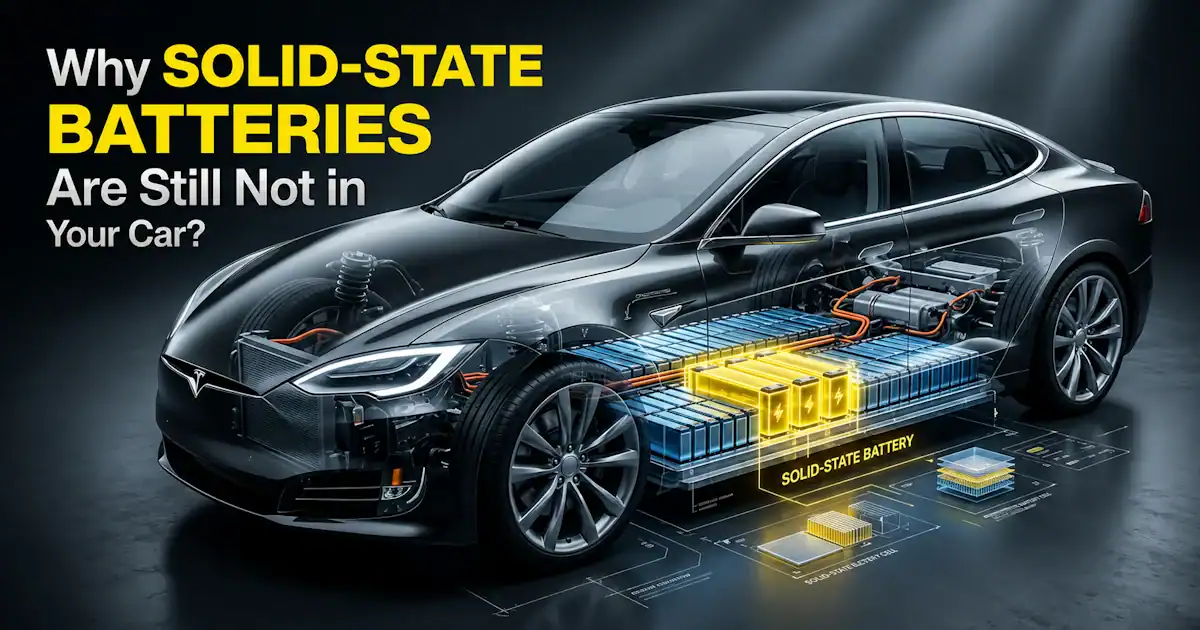
So Where Are All the Solid-State Batteries We Were Promised?
This isn’t new either. Toyota said back in 2012 that production cars would have solid state batteries by 2020. That slid to 2025. Now it’s sitting around 2027 to 2028, for a tiny number of vehicles.
QuantumScape went public in 2020 at a $24 billion valuation, promising cells for Volkswagen by 2024. As of their last shareholder letter, still no product revenue.
None of this is companies overpromising on purpose. These are serious engineering teams who ran into a materials science problem that turned out to be way harder than anyone expected.
So I decided to dig into why. Not the marketing version, the actual physics.
Here’s the short version. Solid state batteries replace the flammable liquid inside a normal EV battery with a solid material. That one change promises more range, faster charging, and a lot less fire risk.
So why isn’t this in your car yet? Turns out there are three pretty fundamental problems standing in the way, and they’re all genuinely hard to solve.
That said, it’s not all stuck in the lab. Semi solid batteries are already on sale in China. Stellantis started road testing actual solid state cells in a Dodge Charger Daytona back in June 2026. And sodium ion, a cheaper alternative chemistry, is entering mass production at CATL this year.
Even so, most analysts are pointing to 2032 to 2035 before true solid state batteries show up in mainstream cars.
📌 Quick Summary
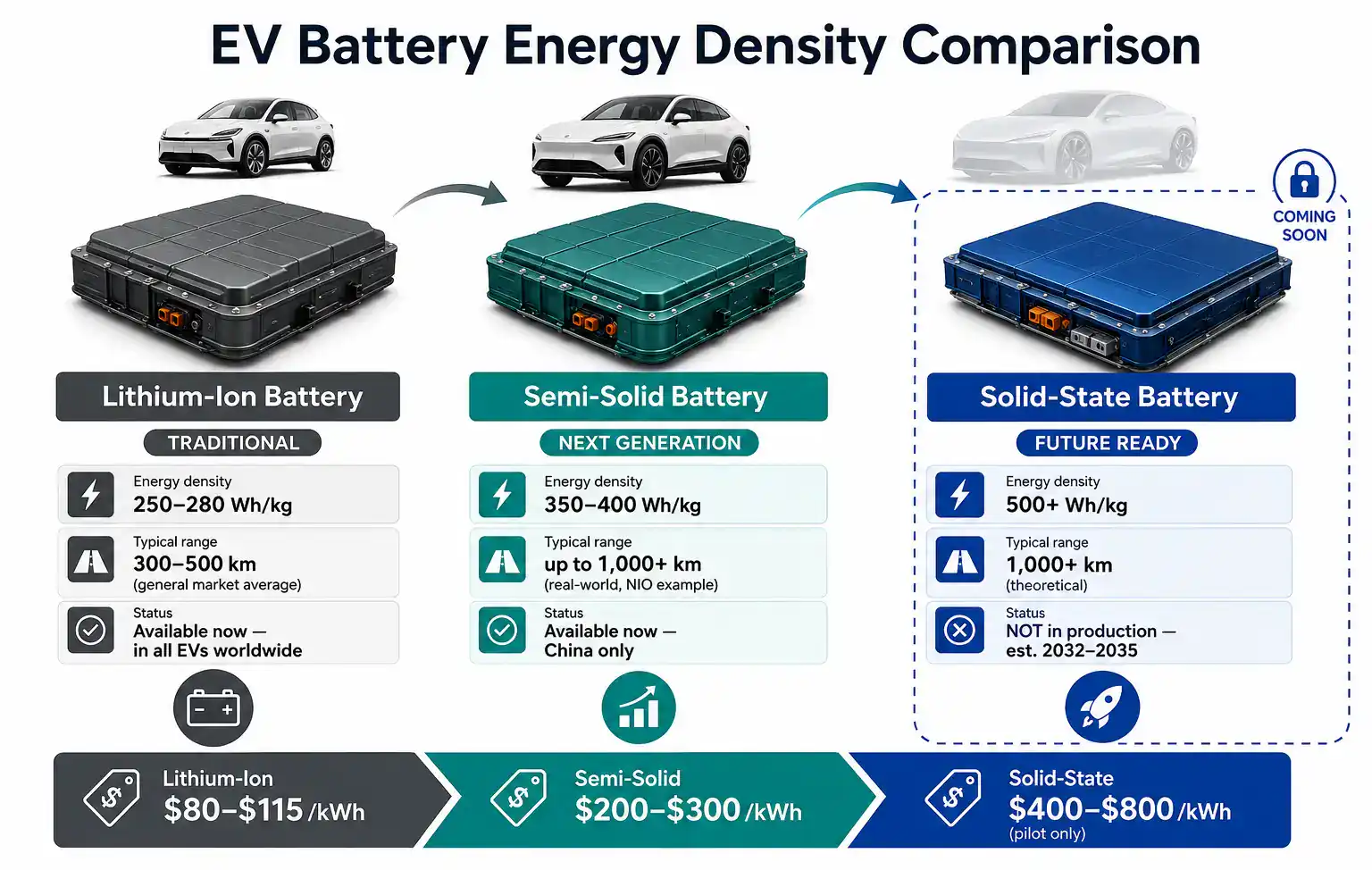
- True solid state batteries currently cost an estimated $400–$800 per kWh, versus $80–$115 for regular lithium ion, roughly a 4 to 10x gap, according to BloombergNEF (2025).
- Lab prototypes need pressure of 100–200x normal air pressure just to keep the solid layers touching. That’s not workable in a car.
- Research from the Max Planck Institute (April 2026) found that soft lithium metal can crack hard ceramic electrolytes from the inside, similar to how freezing water splits rock.
- Semi solid batteries are already in real customer vehicles in China, from NIO, MG, and Dongfeng.
- Stellantis reportedly installed Factorial Energy solid state cells in a Dodge Charger Daytona and began road testing in June 2026, the first such test in North America.
- CATL says it has solved key sodium ion manufacturing issues and will begin mass production in 2026. Sodium ion cells are expected to cost roughly 30% less than standard lithium ion.
- IDTechEx, BloombergNEF, and MIT all point to 2032 to 2035 as the realistic window for mass market all solid state EVs.
Hydrogen vs Electric Cars 2026: Which One Is the Future?
What’s So Special About Solid-State Batteries?
A regular lithium ion battery uses a liquid electrolyte, basically a flammable chemical solvent, sitting between the electrodes. That liquid is a big part of why EV fires happen, and it also caps how much energy you can pack into a given size.
Replace that liquid with a solid (ceramic, glass, or polymer) and three things improve at once:
- Fire risk drops sharply, there’s no flammable liquid left to ignite.
- Pure lithium metal becomes usable instead of graphite, which stores a lot more more energy per gram.
- Energy density could exceed 500 Wh/kg, compared to roughly 250–280 Wh/kg in today’s best lithium ion cells, theoretically enough for an EV to travel over 1,000 km on a single charge without a bigger battery.
Some manufacturers are also claiming 0 to 80 percent charging in 10 to 15 minutes, which would be faster than filling up a gas tank. If even half of this pans out, it’s a genuinely big deal.
The Three Physics Problems Blocking Mass Production
Problem 1: The Layers Don’t Touch Properly
Pour water onto a rough rock and it seeps into every crack on its own. That’s what a liquid electrolyte does inside a battery, it creates full contact everywhere, letting lithium ions move freely.
Now press two rough rocks together instead. They only touch at the high points, leaving gaps everywhere else. That’s roughly what happens inside a solid state battery at the microscopic level, and it leads to high internal resistance and weak power delivery, even on a full charge.
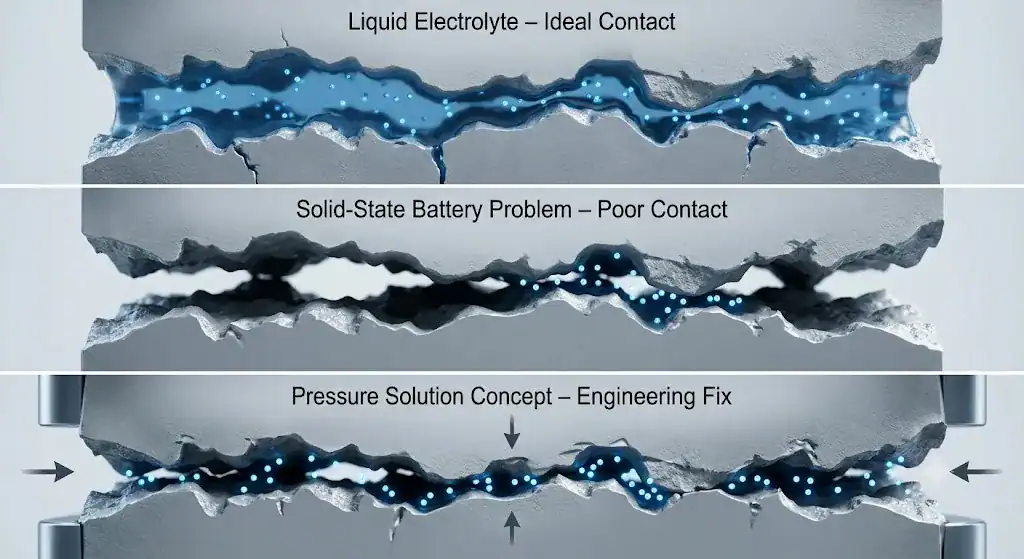
The current lab workaround is to apply constant pressure of 10 to 20 megapascals, about 100 to 200 times normal atmospheric pressure, and keep it there permanently, according to IDTechEx’s 2026 Solid State Battery Report. That’s simply not realistic for a lightweight production car.
Changan Auto filed a patent in May 2026 for a system that applies active pressure to keep contact stable. As of mid 2026, it hasn’t been proven at mass production scale.
Problem 2: Soft Lithium Can Crack Hard Ceramic From Inside
For years, the assumption was that hard ceramic barriers would simply stop lithium dendrites, the tiny metallic whiskers that grow during fast charging and can pierce a separator, causing a fire.
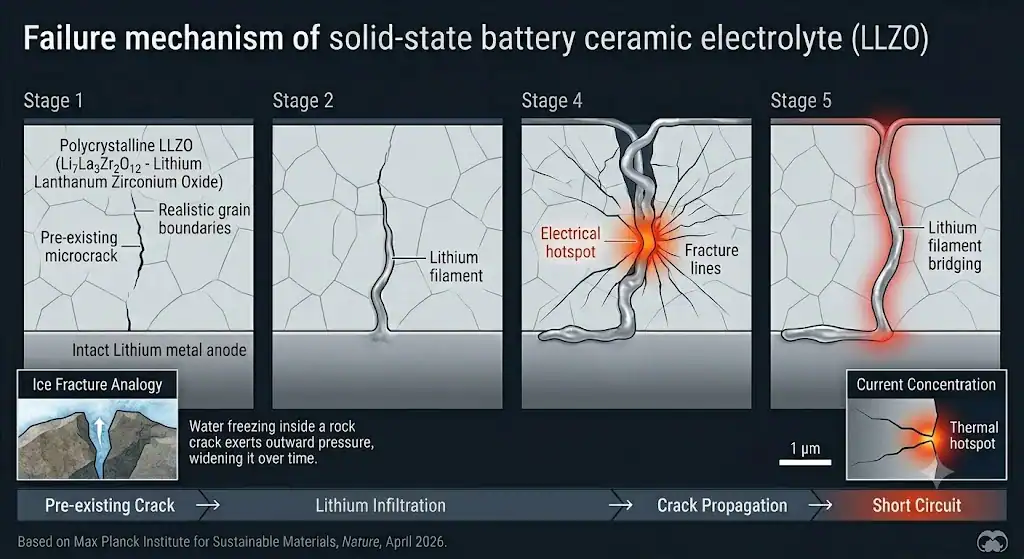
A Nature study published in April 2026 by the Max Planck Institute for Sustainable Materials found that this isn’t quite right. Lithium doesn’t just stop at the ceramic surface, it works its way into tiny existing cracks, builds up pressure from the inside, and widens them further. It’s a similar mechanism to how water freezing inside a rock’s cracks eventually splits the rock apart.
Lead researcher Dr. Yuwei Zhang noted that even though lithium dendrites are soft, “like a gummy bear”, they can still penetrate ceramic electrolytes and trigger short circuits, settling a long running debate among battery engineers.
To make things worse, electrical current concentrates at the crack tip, accelerating the damage. The crack grows, the dendrite grows, and the failure speeds up until the battery shorts out.
Problem 3: The Factory Has to Be Almost Perfectly Dry
The best performing solid electrolytes for EVs are sulfide based, they conduct lithium ions almost as well as liquids do, which is exactly why they’re so heavily researched.
The catch: they react violently with moisture. Even a trace of water vapor can produce hydrogen sulfide gas, the rotten egg smelling gas that’s highly toxic at just a few hundred parts per million, per IDTechEx’s 2026 report.
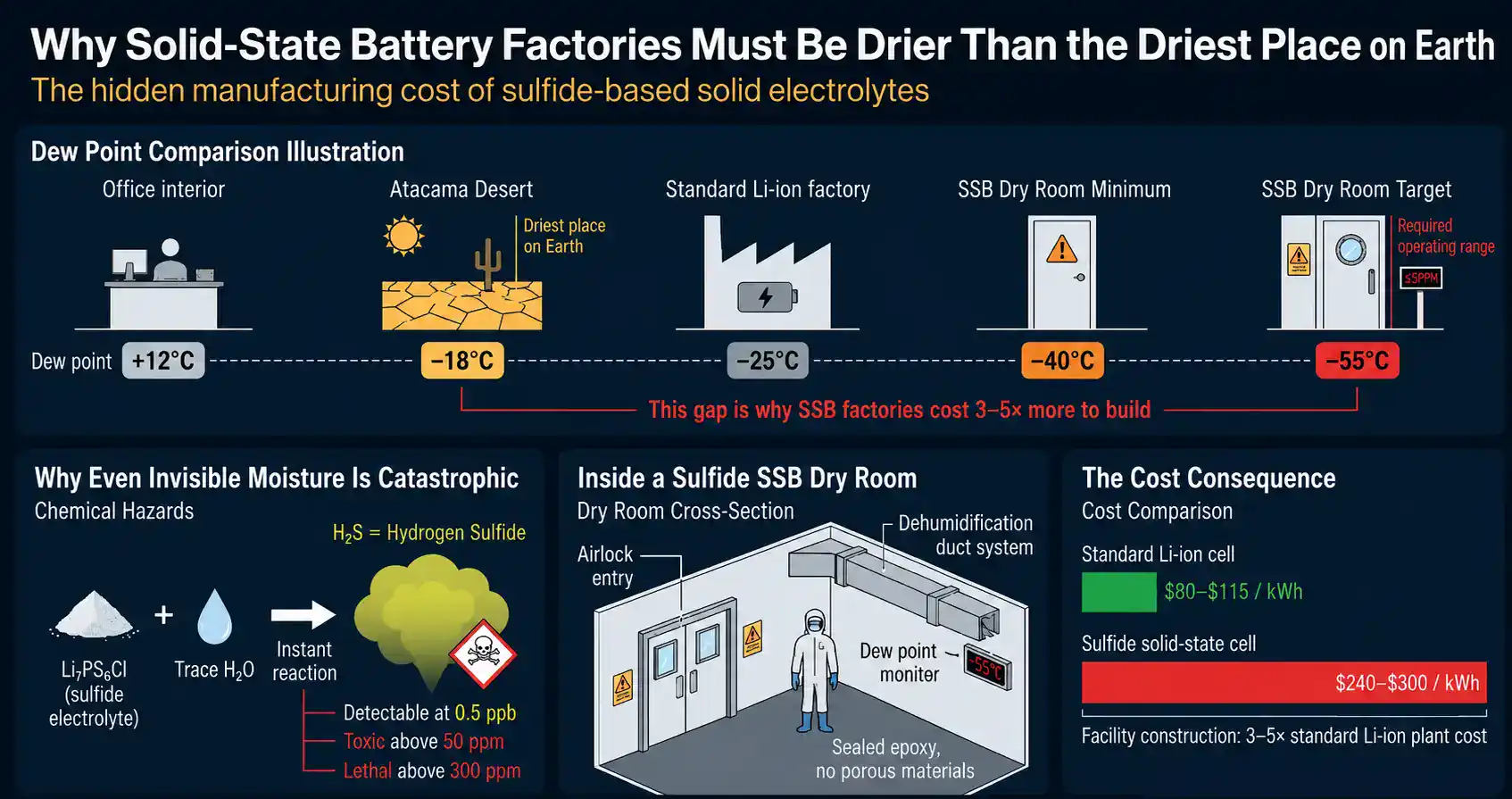
Because of this, every step of manufacturing has to happen in sealed dry rooms with dew points between minus 40°C and minus 60°C. For context, the Atacama Desert in Chile, one of the driest places on Earth, sits around minus 15°C to minus 20°C. These factories have to be drier than the driest natural environment on the planet, while still running machinery and housing workers.
IDTechEx estimates this pushes facility costs to 3 to 5x that of a standard lithium ion plant, which is a big part of why solid state cells currently run $400–$800 per kWh against $80–$115 for lithium ion.
What You Can Actually Buy Today
| Feature | Traditional Lithium Ion | Semi Solid | True All Solid State |
|---|---|---|---|
| Electrolyte type | 100% liquid | Gel or trace liquid | 100% solid |
| Energy density | 250–280 Wh/kg | 350–400 Wh/kg | 500+ Wh/kg (theoretical) |
| Cost per kWh | $80–$115 | $200–$300 | $400–$800 (pilot only) |
| Fire risk | Present | Reduced | Potentially eliminated |
| In customer cars today | Yes, everywhere | Limited, China only | No, nowhere yet |
| Pressure required | None | Minimal | 10–20 MPa in lab |
The semi solid category is where the real commercial action is, and it doesn’t get nearly enough attention.
The MG Anxin Edition is widely considered the first mass produced car with a semi solid battery, built with QingTao Energy using a chemistry with under 5% liquid content. NIO already sells production vehicles with a 150 kWh semi solid pack rated for over 1,000 km of real world range. Dongfeng is targeting commercial production of its own semi solid pack in 2026, claiming over 620 miles of range.
These aren’t concept cars sitting in a showroom for show, people in China are buying and driving these today.
Stellantis Puts Solid State Cells in a Dodge Charger
In June 2026, Stellantis and Factorial Energy reportedly installed Factorial’s FEST solid state cells into a Dodge Charger Daytona development vehicle and began road testing, described as the first solid state battery integration in any vehicle in North America.
According to the companies, these cells have previously demonstrated around 375 Wh/kg energy density, charging from 15% to 90% in roughly 18 minutes, with stable performance from minus 30°C to plus 45°C.
This is still a development vehicle, not something heading to a dealership soon, but moving solid state cells out of a lab and into a real car that drives around safely is a meaningful engineering step.
Earlier in 2025, Factorial also supported a Mercedes Benz EQS that reportedly drove 1,205 km from Stuttgart to Malmö on a single charge on public roads.
Which Companies Are Closest to a Solid State Battery Today
Toyota — Holds over 1,000 solid state patents. Building a factory in Japan, planning to launch with Lexus first. First customer vehicles expected around 2027 to 2028, in very limited numbers.
QuantumScape — Opened its Eagle Line pilot facility in February 2026 and has shipped small batches of QSE 5 cells to Volkswagen for testing. No product revenue reported as of Q1 2026.
BYD — Produced its first pilot sulfide solid state cells in 2024 (20Ah and 60Ah formats), targeting small scale production by 2027. Also launching sodium ion mass production in 2026.
CATL — Targeting solid state prototype cells by 2027, alongside sodium ion mass production starting in 2026. Currently holds 46.6% of China’s EV battery market.
Greater Bay Tech — Backed by GAC Group. Produced first A sample all solid state cells in April 2026, reaching 260–500 Wh/kg and reportedly passing nail penetration tests without fire. Independent verification still pending.
ProLogium — Taiwan based, has shipped over 800,000 solid state cells. Went public on Nasdaq in May 2026 at a $3.8 billion valuation. Building a factory in Dunkirk, France, targeting mass production by late 2028.
Donut Lab — A Finnish startup that has put solid state cells into Verge Motorcycles, with customer deliveries starting Q1 2026, arguably the first production vehicle using solid state cells, though motorcycles are a much simpler case than cars.
Samsung SDI — Has published specs for a 500 Wh/kg cell targeting mass production around 2027, though independent analysts including J.P. Morgan expect that timeline to slip.
The Battery Nobody’s Talking About: Sodium Ion
While everyone’s watching solid state, another battery chemistry is quietly heading into mass production right now. CATL said on May 30, 2026 that it has resolved key manufacturing bottlenecks and that sodium ion mass production will begin before the end of the year.
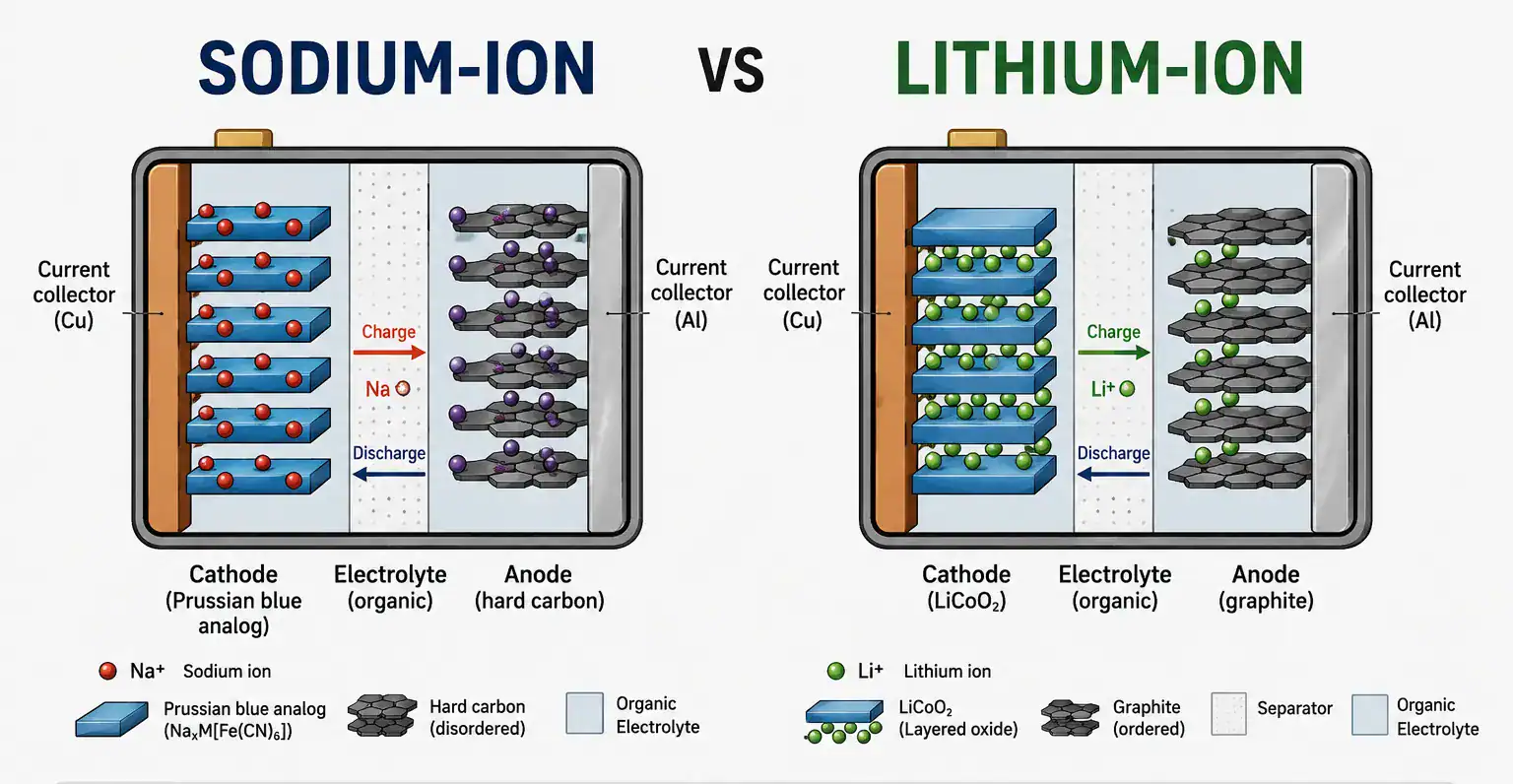
The first mass produced sodium ion passenger car is the Changan Nevo A06, a joint project between CATL and Changan Automobile, revealed in February 2026 and expected to reach the market by mid 2026.
Sodium is far cheaper than lithium as a raw material, CATL expects sodium ion cells to cost roughly 30% less than standard lithium iron phosphate batteries. They also handle extreme cold much better, retaining around 90% of their capacity at minus 40°C, where lithium ion struggles. And they sidestep the lithium, cobalt, and nickel supply chain entirely.
MIT Technology Review named sodium ion one of its 10 Breakthrough Technologies of 2026, and CATL believes it could eventually capture 30 to 40% of the global battery market.
Current energy density sits around 150–175 Wh/kg, lower than premium lithium ion, but plenty for city cars, commuter EVs, and buses. For everyday driving, sodium ion could realistically hit the mass market well before solid state does.
Solid State Batteries Are Already Around You, Just Not in Your Car
According to a 2026 Coherent Market Insights report, thin film solid state batteries hold around 90.5% of the market in wearables, medical devices, smart cards, and IoT sensors.
They’re already inside wireless hearing aids, implantable cardiac monitors, and industrial sensors. The chemistry itself isn’t the mystery.
The real challenge is making them big, cheap, and durable enough for a car. A tiny thin film battery never has to deal with the pressure, heat, and current demands of an EV pack. The same physics that make these batteries easy at a small scale are exactly what makes scaling them up so hard.
A Realistic Timeline
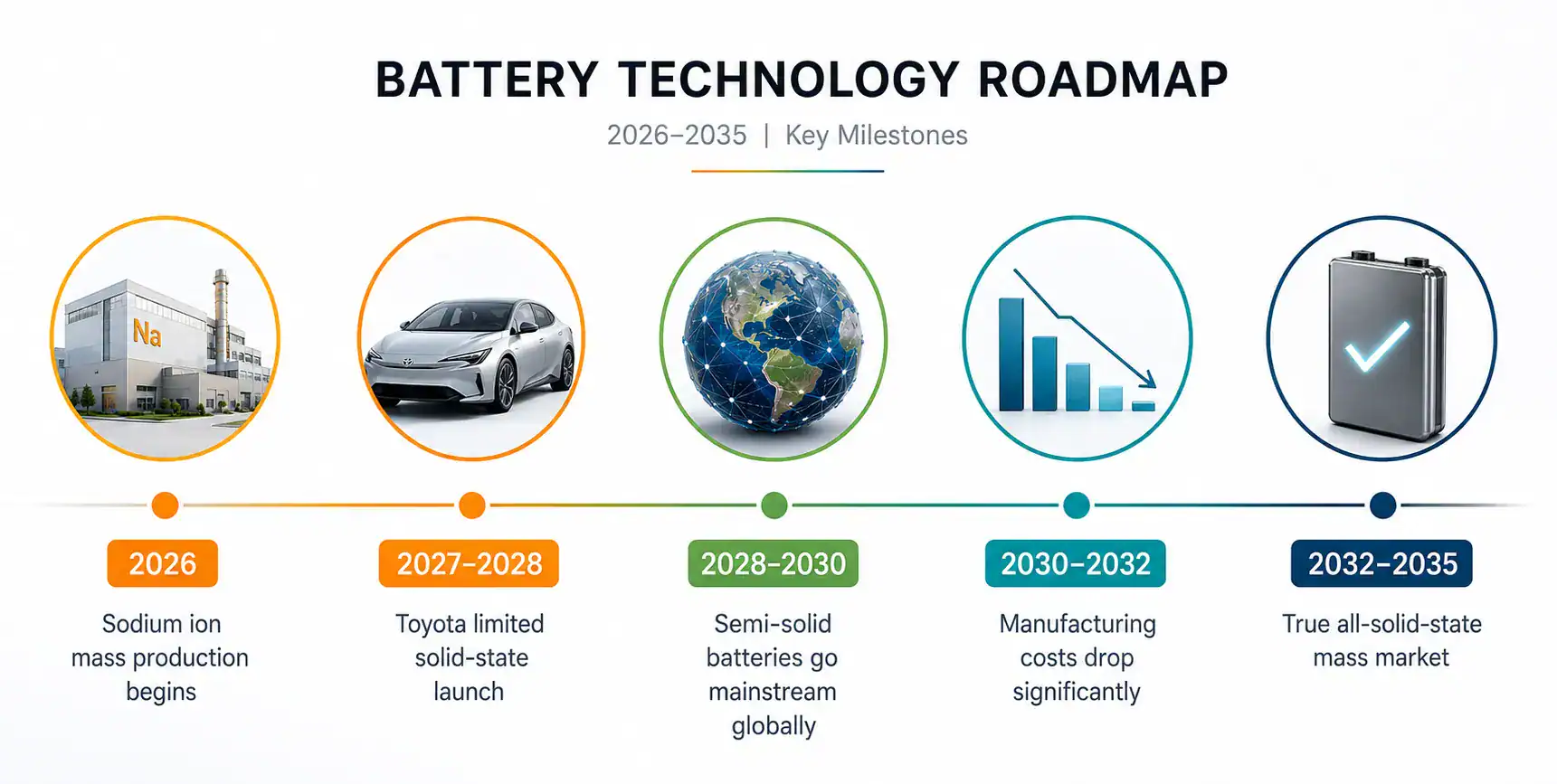
2026 to 2028: A handful of near solid or semi solid batteries show up in expensive, limited production cars from Toyota and a few others. Meanwhile, sodium ion enters mass production and starts appearing in affordable Chinese EVs. Stellantis and Factorial continue real world road testing in North America.
2028 to 2030: Manufacturing improves meaningfully, better interface coatings and lessons from pilot lines start bringing costs down. Semi solid batteries spread into more mainstream EVs globally. ProLogium’s France factory is also targeting mass production in this window.
2032 to 2035: The most realistic window for true all solid state batteries to reach large scale production, assuming the remaining technical hurdles get solved. MIT Energy Initiative research from 2025 also projects cost parity with lithium ion around 2035.
Worth keeping in mind: lithium ion isn’t standing still either. Silicon anodes, dry electrode manufacturing, and smarter pack designs are making lithium ion cheaper and more energy dense every year. Solid state isn’t racing against a fixed target, it’s racing against a technology that keeps getting better too.
China’s Official Battery Roadmap
China produces roughly 70% of the world’s lithium ion batteries, so it has every financial incentive to lead on solid state too. The government’s official national battery roadmap, via the Ministry of Industry and Information Technology, targets 350 Wh/kg for liquid based cells by 2025, 400 Wh/kg for hybrid cells by 2030, and 500 Wh/kg for true solid state batteries by 2035.
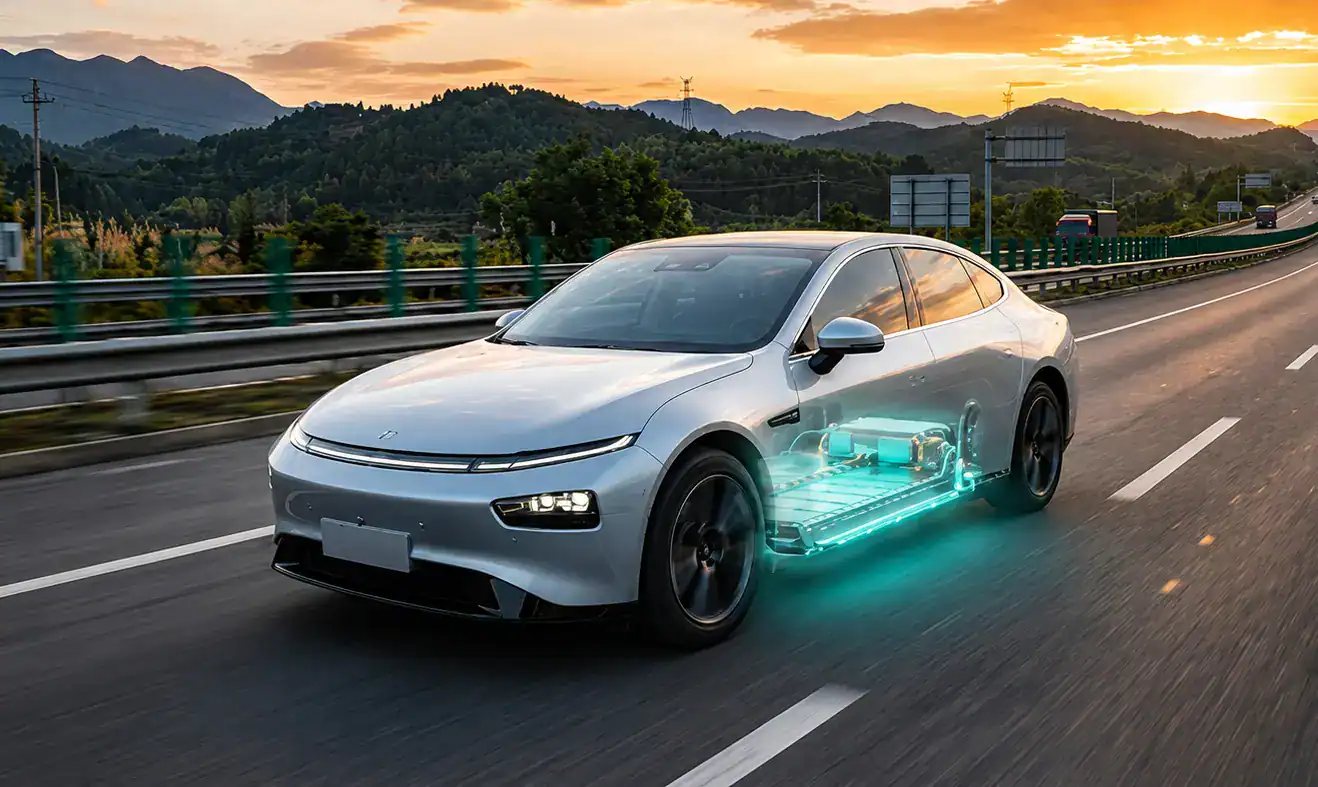
China is also rolling out a national solid state battery standard in July 2026, setting official technical requirements for domestic manufacturers. Image Credit: Engineering Junkies
At the 2025 World Power Battery Conference, leaders from major Chinese battery and automotive companies told investors plainly that all solid state batteries still aren’t ready for large scale production, even the most optimistic voices in the industry are acknowledging this technology has a way to go.
Frequently Asked Questions: Solid State Batteries
⌄
⌄
⌄
⌄
⌄
⌄
⌄
⌄
⌄
Written by
Engineering Junkies Team
We are a team of engineers, researchers and technology writers who love breaking down complex topics into clear and honest content. Every article we publish is built on real research and honest writing.
You can reach us through our Contact Us page.