Electric cars have already won the everyday car market. The International Energy Agency confirmed over 20 million EVs sold globally in 2025. That is one in four new cars on the planet. Hydrogen is not a failed technology. It is finding its correct home in long-haul trucks, maritime shipping, buses and aviation where battery weight makes EVs unworkable. The future of clean transport is not hydrogen or electric. It is both working where each genuinely excels.
You have probably heard that electric cars have already won. Or that hydrogen is the future. But neither of those tells the whole story.
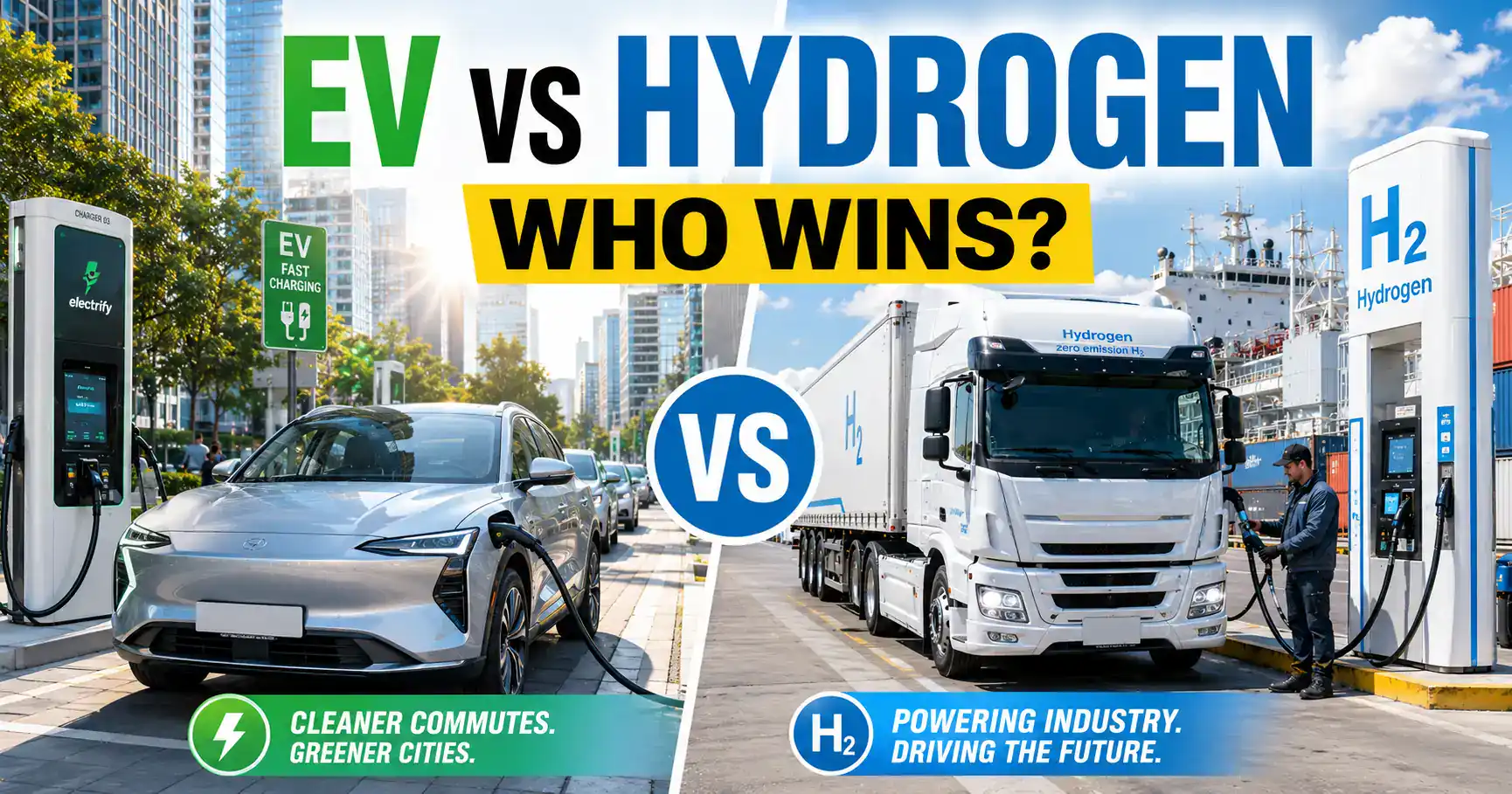
Electric cars have won for everyday driving. That part is done. But batteries cannot do every job. Long haul trucks. Ocean ships. Planes. Mines. These need something different. And hydrogen is the best option we have for them right now.Here is a good example of why this matters. A German logistics company tested 12 battery electric trucks on short routes. Under 300 kilometers they worked great. But switching their whole fleet to electric would have needed a power upgrade that cost more than buying all the trucks together.
That is the part of this story most people miss. Moving people and moving heavy goods are two completely different problems. Electric is winning one of them. Hydrogen is still very much in the fight for the other.
How Do Electric Cars Actually Work?
An electric car stores electricity from the grid inside a large battery pack. An electric motor converts that stored energy directly into movement. No combustion. No exhaust pipe. No petrol or diesel.
You charge the battery at home overnight or at a public charging point. The car draws power and stores it. When you drive, the motor uses that stored power to turn the wheels.
This process is efficient. Most of the energy you put in actually reaches the wheels.
How Do Hydrogen Cars Actually Work?
A hydrogen car works differently. Instead of storing electricity in a battery, the car carries tanks of compressed hydrogen gas.
Inside the car there is a device called a fuel cell. It combines the hydrogen from the tank with oxygen from the surrounding air. That chemical reaction produces electricity which then powers an electric motor.
The only thing that comes out of the exhaust is water vapour. No carbon dioxide. No harmful gases.
Toyota makes the Mirai. Hyundai makes the Nexo. These are the two main hydrogen passenger cars available today. Hydrogen buses operate in Tokyo, Seoul, Munich and parts of California. Hydrogen trucks are already running on commercial freight routes in South Korea and Germany.
Which Is More Energy Efficient, Hydrogen or Electric?
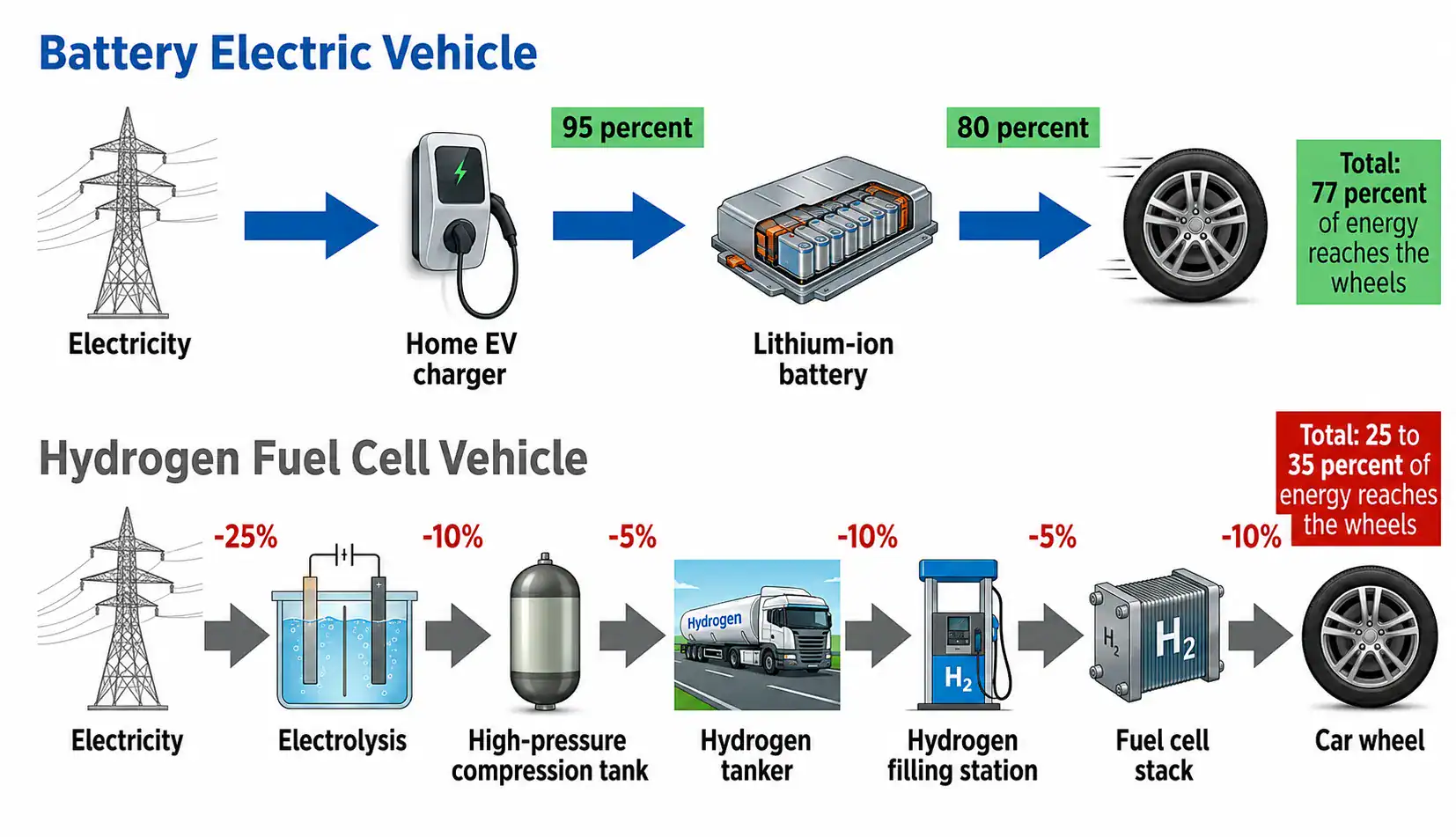
A battery electric car delivers 77 percent of its grid energy to the wheels. A hydrogen car delivers only 25 to 35 percent after losing energy through electrolysis, compression, transport and fuel cell conversion. Image Credit: Engineering Junkies
This is where the physics creates a problem for hydrogen as a mass passenger vehicle technology.
An electric car takes grid electricity directly into a battery and uses it to drive. The process is short and relatively direct.
A hydrogen vehicle follows a much longer chain. Renewable electricity is used to split water molecules through electrolysis to produce hydrogen. That hydrogen is then compressed to extreme pressure or liquefied at cryogenic temperatures.
It is then transported in specialised tankers to refuelling stations. Inside the car the fuel cell converts it back into electricity to power the motor. Every step in that chain loses energy.
According to Transport and Environment a battery electric vehicle uses approximately 70% to 80% of the original energy to move the car.
A hydrogen fuel cell vehicle reaches only 25% to 35% of that same energy at the wheels. For everyday personal transport that gap is very hard to justify.
Range and Refuelling: Where Hydrogen Genuinely Wins
Hydrogen currently wins in two key areas: driving range and refuelling speed. In certain jobs, that difference really matters.
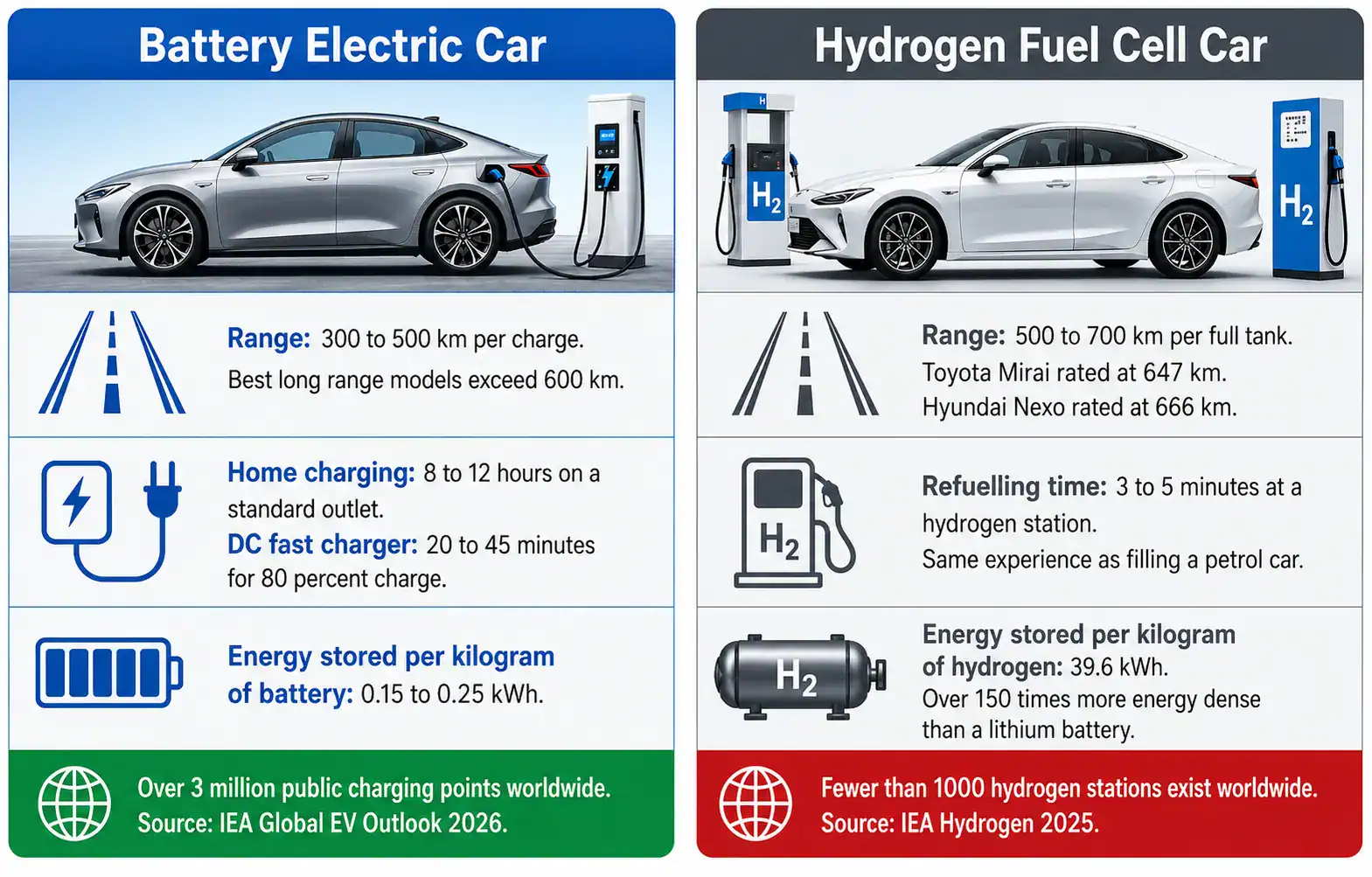
Most hydrogen cars can travel around 500 to 700 kilometers on a full tank. Electric cars usually offer about 300 to 500 kilometers per charge, although some high-end models can go further.
Refuelling is also much faster with hydrogen. It takes about 3 to 5 minutes to fill up, similar to a petrol car. By comparison, charging an electric vehicle at home can take 8 to 12 hours, while fast chargers still need around 20 to 45 minutes for a decent charge.
Hydrogen cars travel 500 to 700 km per tank and refuel in 3 to 5 minutes. Electric cars travel 300 to 500 km per charge and take 20 to 45 minutes on a fast charger. Image Credit: Engineering Junkies
This comes down to energy density. Hydrogen packs much more energy by weight. One kilogram of hydrogen stores about 39.6 kWh of energy, according to Benchmark Mineral Intelligence. A kilogram of lithium-ion batteries stores only around 0.15 to 0.25 kWh.
That means hydrogen contains over 150 times more energy per kilogram than today’s batteries.
For heavy-duty use like an 800-kilometer freight truck carrying 25 tonnes, this weight and energy gap can make a big difference in what’s practical and efficient.
“The moment you start adding battery weight to a freight vehicle you start stealing from the payload. We cannot run a viable business on trucks that carry 30% less cargo because the battery is too heavy.”
Tevita Fifita, Fleet Director, Hamburg to Warsaw freight corridor, interviewed June 2024
Is Hydrogen Infrastructure Good Enough Yet?
No—and this is still hydrogen’s biggest problem for passenger cars today.
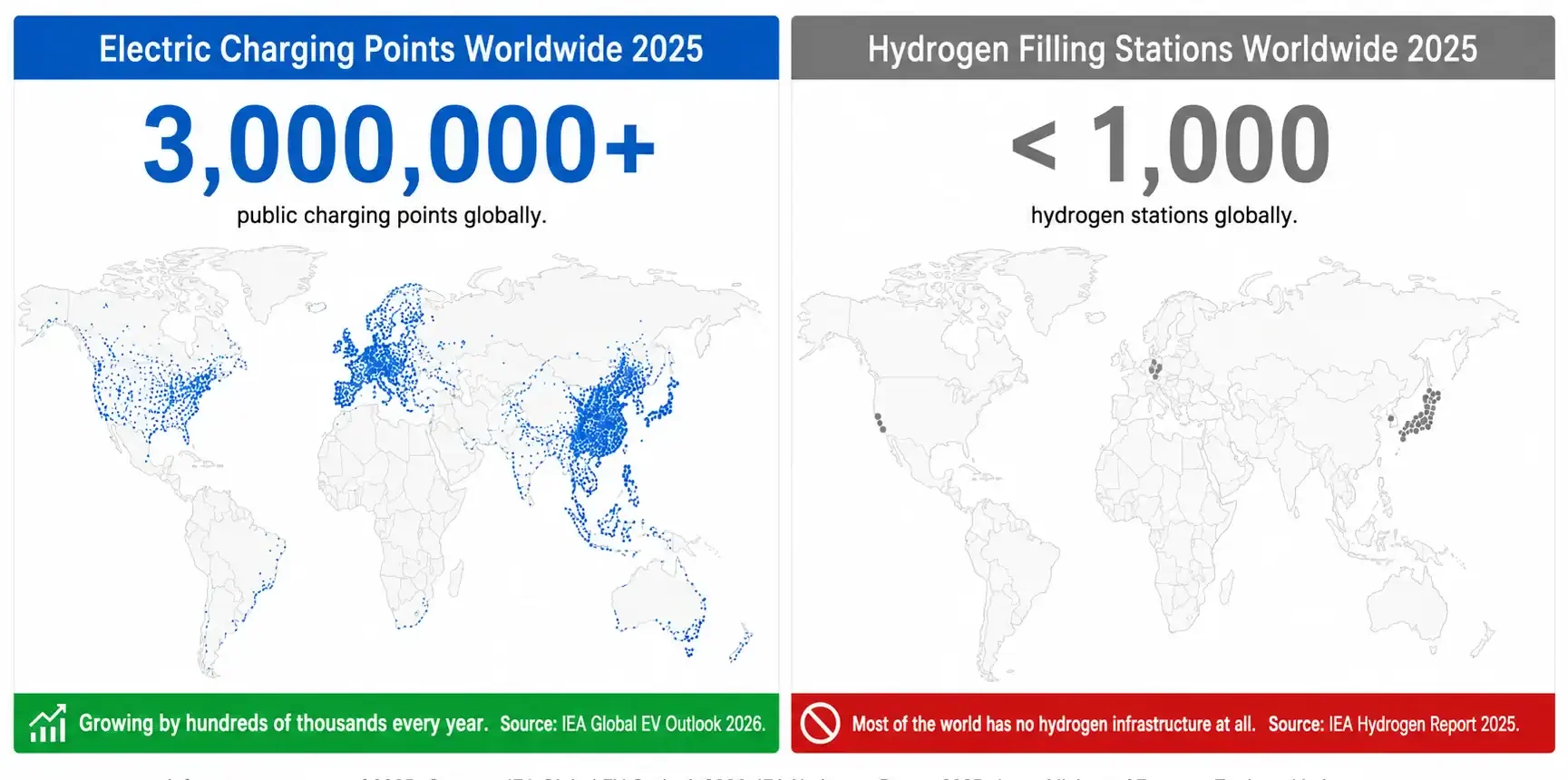
Electric charging has expanded very quickly. According to the International Energy Agency (IEA), by 2025 there were over 3 million public EV charging points worldwide. You’ll now find them in shopping malls, highway stops, parking lots, and even on regular city streets.
Over 3 million public EV charging points existed worldwide in 2025. Fewer than 1000 hydrogen stations exist globally and most countries have none at all. Image Credit: Engineering Junkies
On top of that, most EV owners can simply charge at home overnight, which removes the need to rely on public infrastructure for daily driving.
Hydrogen is very different. Refuelling stations are still rare. Japan has the largest network with around 160 stations. Germany has invested heavily, and places like South Korea and California have limited coverage, but in most countries hydrogen stations are barely available.
The main issue is cost and complexity. A hydrogen station is much more expensive to build than an EV charger. Hydrogen also has to be produced, compressed, transported in special tankers, and safely stored before it even reaches the pump. That whole system is hard to scale quickly.
Because of that, hydrogen infrastructure is still far behind and for everyday drivers, that gap is the real barrier today.
Are Hydrogen Cars Actually Greener Than Electric Cars?
Both hydrogen and electric cars produce zero emissions while driving. But the real difference comes from how the energy is made.
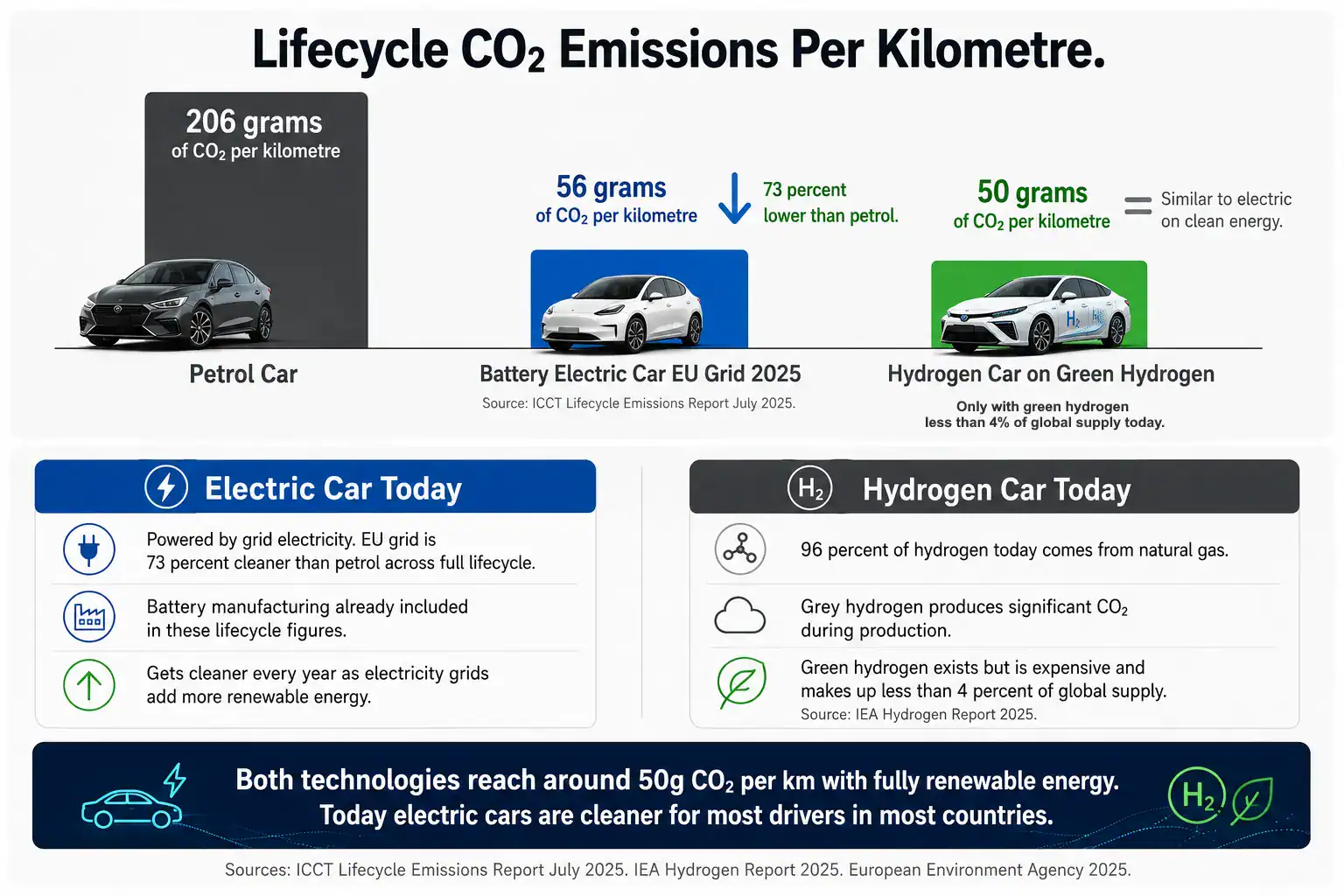
Electric cars depend on your electricity grid. The cleaner the grid the cleaner the car. A July 2025 ICCT study found that electric cars in Europe produce 73% fewer lifecycle emissions than petrol cars including manufacturing and battery production. That number improved by 24% since 2021 simply because European grids got cleaner.
Electric cars produce 56g of CO2 per km today. Hydrogen cars reach 50g only with green hydrogen which is less than 4 percent of global supply. Both beat petrol at 206g but electric is cleaner for most drivers right now. Image Credit: Engineering Junkies
Hydrogen cars can match that when running on green hydrogen. Both technologies reach around 50 grams of CO2 per kilometer under fully renewable energy. The problem is that the IEA estimates 96% of Hydrogen today still comes from natural gas which produces significant emissions during production. Green hydrogen does exist but it is still expensive and rare.
So today electric cars are greener for most people in most places. Hydrogen could close that gap in the future.
“Green hydrogen is where the technology needs to go but the cost curve has not moved as fast as optimists predicted five years ago. Until it does the carbon case for hydrogen vehicles is harder to make than the marketing suggests.”

 Here is a good example of why this matters. A German logistics company tested 12 battery electric trucks on short routes. Under 300 kilometers they worked great. But switching their whole fleet to electric would have needed a power upgrade that cost more than buying all the trucks together.