Ever since ChatGPT launched in November 2022 the conversation about AI stealing jobs has never really stopped. Artists worried. Bankers worried. Writers worried. Then Elon Musk unveiled the Tesla Optimus Gen II humanoid robot and the worry spread even further.
But a major study from MIT tells a different and more grounded story. At least for now.
Researchers at MIT’s Computer Science and Artificial Intelligence Laboratory published a paper called Beyond AI Exposure in January 2024. Their finding was simple and surprising. For most jobs AI is still too expensive to make financial sense as a replacement for human workers.
What the MIT Study Actually Found
The research team surveyed around 1000 visually assisted tasks across 800 different occupations in the United States. They focused on jobs where computer vision is used such as teaching baking and property appraisal. Computer vision is the branch of AI that lets machines read and interpret images and visual information.
What they found was that only 23% of the wages paid to workers in these roles would make it financially worthwhile for employers to replace humans with AI right now. In most cases the cost of installing and running an AI system was simply higher than paying a person to do the same job.
Neil Thompson the Principal Investigator at MIT CSAIL and the Initiative on the Digital Economy explained it directly. The findings point to a more gradual integration of AI into various sectors which directly contrasts with the rapid job displacement that so many people have been predicting.
The study was funded by the MIT-IBM Watson AI Lab.
A Real Example: The Bakery
The study used a bakery as a practical example. A computer vision system could technically inspect ingredients for quality control. But that task makes up only about 6% of what a bakery worker actually does in a day.
Installing and running the AI system for that one task would cost more than it saves. A human remains the cheaper and more flexible option.
This is the finding repeated across industry after industry. AI can handle parts of a job but jobs are made of many tasks and the economics rarely add up in AI’s favour right now.
Even With Falling Costs It Will Take Decades
The researchers did not just look at today’s numbers. They modelled what happens as AI costs fall over time.
Even if the cost of AI systems drops by 20% every year it would still take decades before computer vision becomes cheaper for most tasks. The researchers wrote that even with a 50% annual cost decrease it would take until 2026 before half of vision tasks give machines an economic advantage.
And by 2042 there would still be tasks where human workers hold the edge.
For comparison a Goldman Sachs report published in 2023 estimated that generative AI could affect up to 300 million jobs globally or around 18% of all work worldwide. The MIT study suggests the real-world timeline for that disruption will be far slower than that headline number implies.
But a Newer MIT Study Changes the Picture
In late 2025 MIT came out with a second study and the findings were very different from the first one.
This time they built a tool called the Iceberg Index together with Oak Ridge National Laboratory. It looked at 151 million American workers across every state and mapped out exactly where AI can already do their jobs as well as they can and for less money.
The result was sobering. AI can now realistically replace work worth 1.2 trillion dollars in wages. That covers jobs in finance healthcare HR logistics and professional services.
The 2024 study said AI was not affordable enough yet to replace most workers. The 2025 study says that for a big and growing part of the economy it now is.
What really caught the researchers off guard was where the risk showed up. It is not just Silicon Valley or New York. The threat is spread across every single state including smaller inland and rural areas that never come up in these conversations.
Tennessee North Carolina and Utah are already using the Iceberg Index to find out which communities are most at risk down to the zip code level so they can start preparing workers before the jobs disappear rather than after.
Which Jobs Are Most at Risk Right Now?
The jobs most at risk from AI are not the ones people usually worry about.
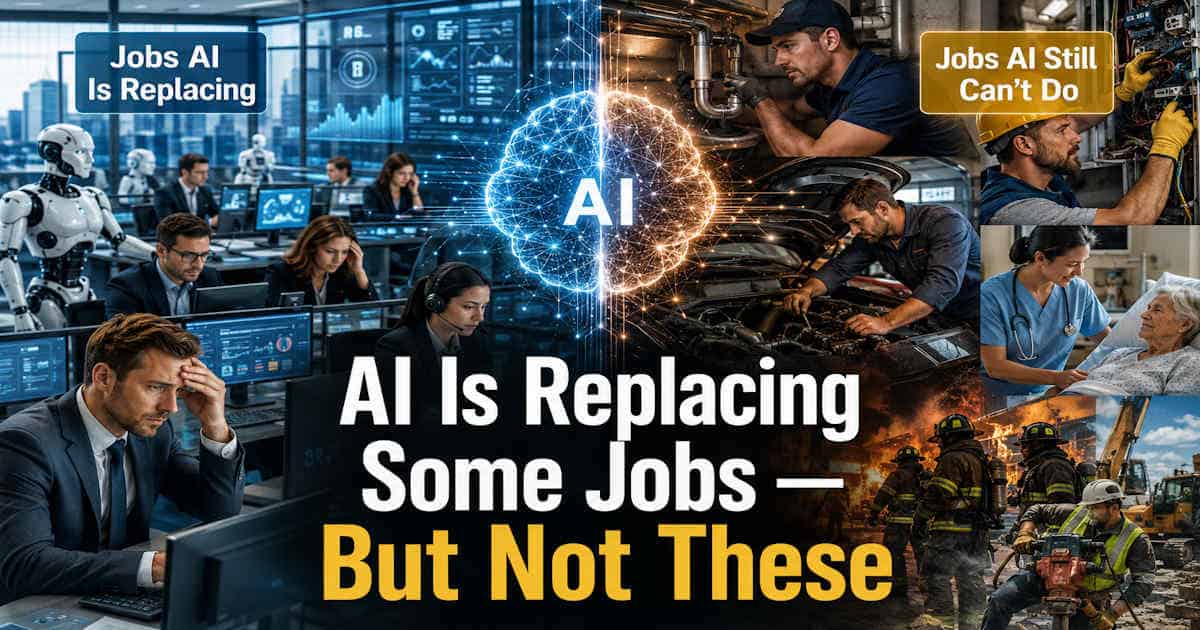
Plumbers electricians mechanics and construction workers are among the safest. AI cannot show up on a job site fix a pipe or rewire a building. Physical presence and real-world judgment make these roles extremely hard to automate.
The real pressure is on white-collar workers. Banking and finance has 69% of its skills facing transformation. AI chatbots already handle 70 to 85% of basic customer service tickets. Scheduling data entry and email management are being automated across entire admin departments.
JPMorgan’s CEO Jamie Dimon confirmed in 2025 that the bank had already automated 20% of its back-office positions. Goldman Sachs estimates 40% of trucking and delivery jobs could disappear by 2035.
The workers who felt safest because of their degrees and desk jobs are actually more exposed than the people fixing things with their hands.
The Jobs Least at Risk
Based on current research the roles with the strongest protection against AI replacement share one thing. They require genuine human presence empathy and unpredictable real-world judgment.

Nurses and healthcare workers top the list. A nurse reads a patient’s fear in their face responds to unexpected changes and provides care that is fundamentally about human trust. AI can support those roles but it cannot perform them. Nurse practitioners are actually projected to grow by 52% from 2023 to 2033.
Therapists and counsellors are similarly protected. Real progress in therapy depends on trust built over time through non-verbal cues meaningful silence and shared history that no machine can genuinely replicate.
Skilled tradespeople including electricians plumbers and mechanics work in environments that change constantly. A plumber tracking a hidden leak uses instinct and experience. A firefighter makes split-second decisions in chaos. These roles score near zero on AI applicability.
Teachers coaches and social workers also remain resilient because their value comes from emotional connection and adaptive human response in real time.
The Workers Most at Risk Are Entry Level
Entry-level workers are the most vulnerable. Nearly 50 million US jobs at the entry level are at risk in coming years. As companies adopt AI the first roles to go are the junior positions that involve repetitive structured tasks like data processing document review basic customer queries and routine reporting.
Andrew Yang who has spoken to CEOs across industries put it plainly. A lot of them are already downsizing and in many cases they are specifically replacing entry-level workers with AI. That is where the displacement is most visible right now.
Workers aged 18 to 24 are 129% more likely than those over 65 to worry that AI will make their job obsolete. That anxiety reflects a real and documented risk at the bottom of the career ladder.
The One Skill That Protects You Regardless of Your Job
Here is the single most actionable finding buried across all of this research.
PwC found that workers who use AI effectively earn a 56% wage premium over those who do not. The World Economic Forum found that 83% of companies now prioritise AI skills in their hiring.
Microsoft’s research showed that in 40% of conversations between humans and AI the two were working on different parts of the same task together rather than competing.
The future is not humans versus AI. It is humans who use AI versus humans who do not. That gap in earnings and employability is already opening up and it will widen fast.
The MIT study itself concluded that AI job displacement will be substantial but gradual and that there is room for policy retraining and adaptation to reduce the damage. The window is open. But it will not stay open forever.
Written by
Engineering Junkies Team
We are a team of engineers, researchers and technology writers who love breaking down complex topics into clear and honest content. Every article we publish is built on real research and honest writing.
You can reach us through our Contact Us page.