
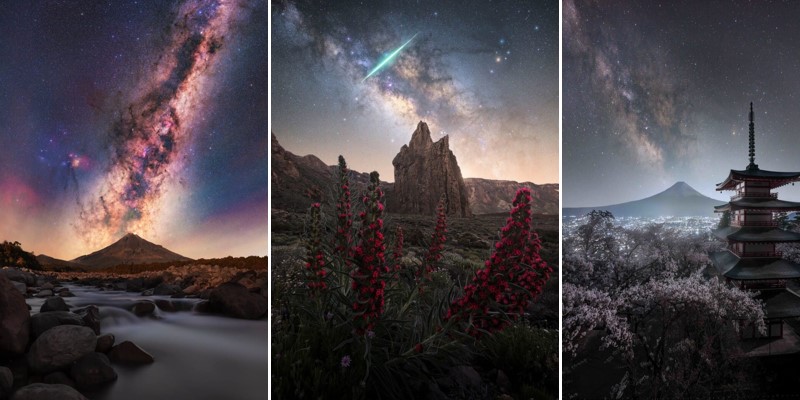
Have you ever looked up at a truly dark sky and felt completely small?
That one moment is why thousands of photographers haul heavy gear to deserts, mountaintops, and frozen riverbanks in the middle of the night every single year.
They are all chasing the same thing: the perfect Milky Way image.
And every year, Capture the Atlas collects the best of those efforts into one free collection that stops the internet in its tracks.
What Is the Milky Way Photographer of the Year?
It is an annual photo contest run by travel photography blog Capture the Atlas.
Astrophotographer Dan Zafra has curated it since the beginning. Each year he reviews thousands of entries and hand-picks 25 images based on four things: technical quality, originality, the story behind the shot, and how much it inspires others to try.
That last point is the whole reason the contest exists.
Many past participants say they traveled to a location specifically because they saw it in a previous year’s winning collection. One photographer’s image becomes another photographer’s destination. The cycle keeps going.
The contest now receives over 6,500 submissions per year from photographers across 15 or more nationalities. It has become one of the most respected astrophotography showcases in the world.
15 Winning Milky Way Images Worth Seeing
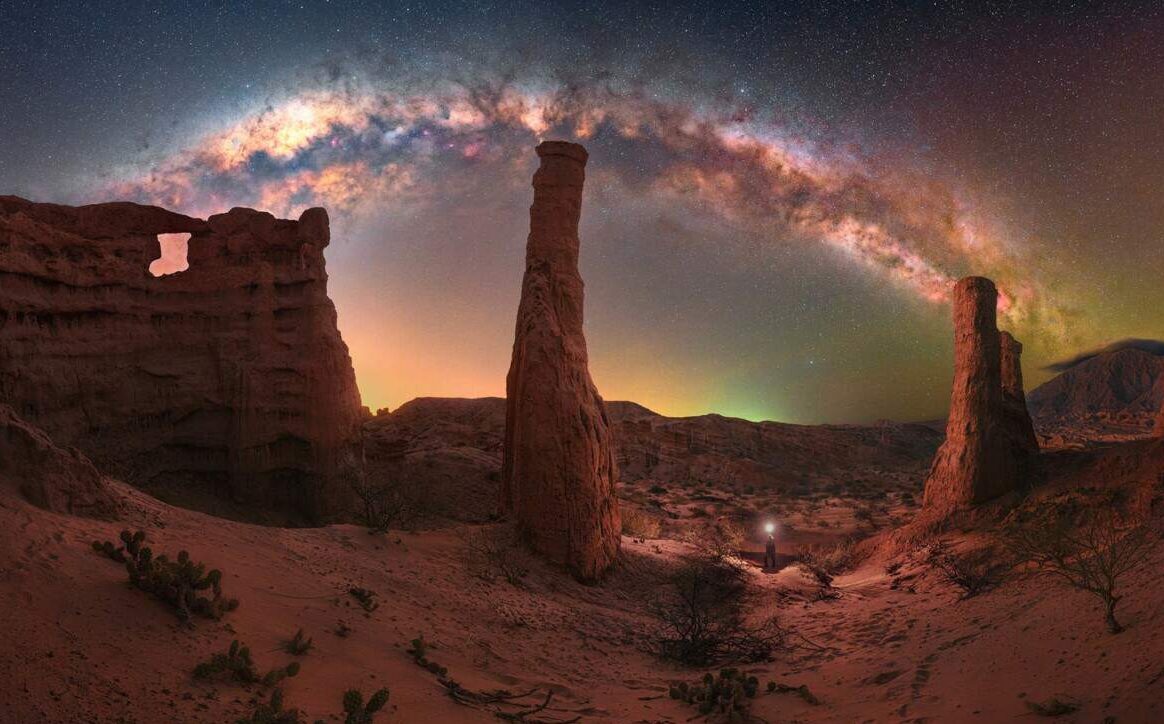
1. Cafayate Star Factory — Gonzalo Javier Santile | Argentina
Gonzalo Santile positioned himself beneath a natural rock arch in the Cafayate Desert and waited for the galaxy to align perfectly overhead.
He used a modified Nikon D750 to capture it. Camera modification removes an internal filter that blocks certain wavelengths of light. The result: deep reds and pinks in the galactic core that a standard camera simply cannot see.
A star tracker let him expose for 43 seconds without the stars blurring into streaks.
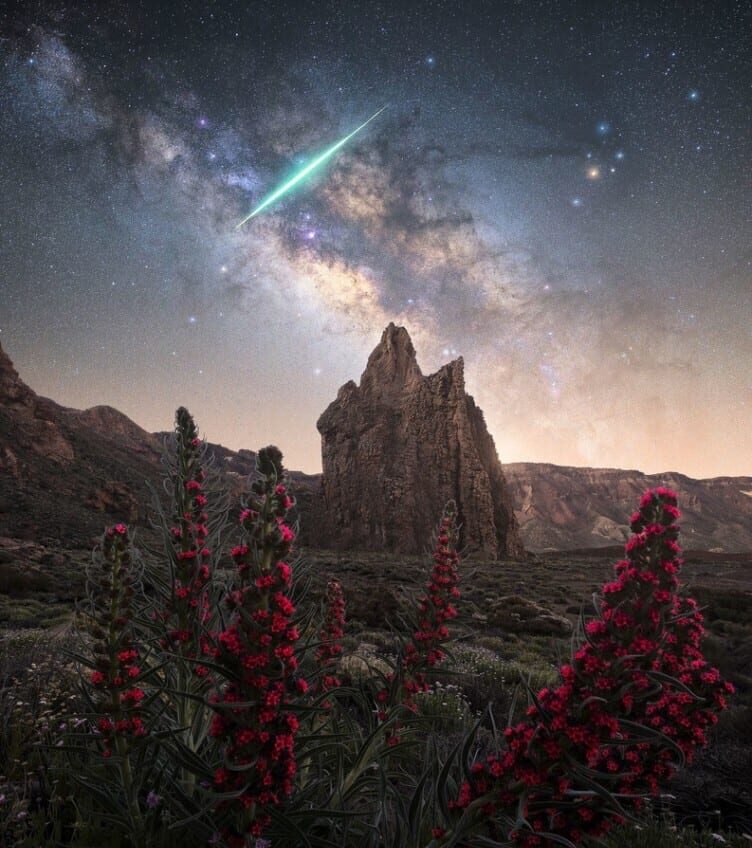
2. The Cathedral Light Show — Roksolyana Hilevych | Tenerife, Spain
A meteor crossed the sky at exactly the right moment. Roksolyana Hilevych caught it on camera.
Behind the meteor: a mountain shaped like a cathedral. In the foreground: bright red tajinaste flowers that only bloom in spring and only in the Canary Islands.
She planned the location and timing carefully. The meteor was pure luck.
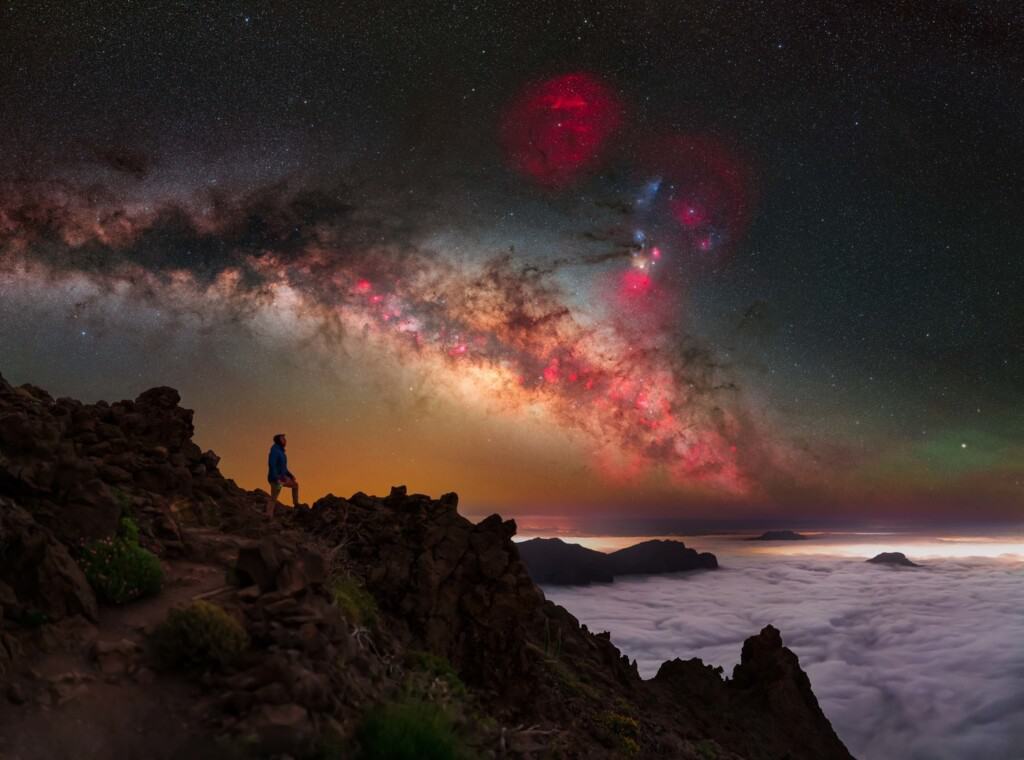
3. The La Palma Astroexperience — Jakob Sahner | La Palma, Spain
Jakob Sahner photographed the Milky Way from above that cloud layer. The result looks like the galaxy is floating over a white ocean stretching to the horizon.
La Palma has some of the strictest light pollution laws on Earth. The island government protects its skies the way other places protect coastlines or forests. It is one of the best places in the Northern Hemisphere to photograph the night sky.
4. The Eyes of the Universe — Mihail Minkov | Bulgaria
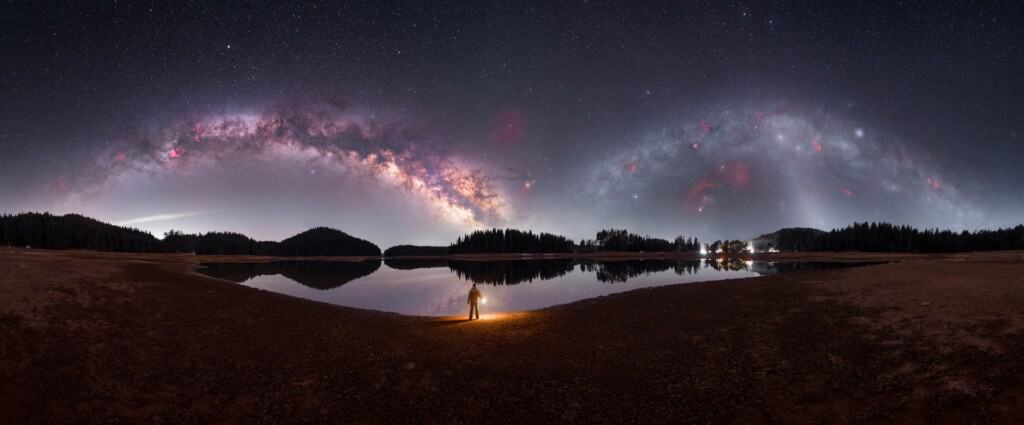
Mihail Minkov photographed the same location in Bulgaria twice: once in summer for the galactic core and once in winter for the cold-season Milky Way. He then blended both into a seamless 360-degree panorama.
The result shows both versions of the galaxy visible at once, something the laws of physics do not allow.
5. Lut Glow — Isabella Tabacchi | Iran
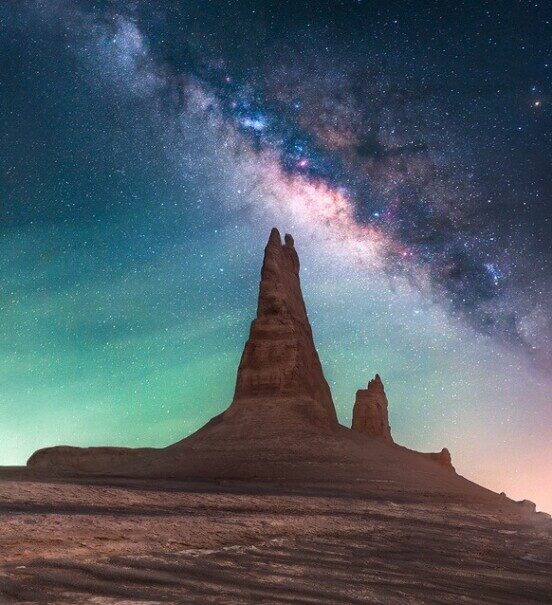
Isabella Tabacchi photographed a jagged rock formation reaching toward the sky with the Milky Way above it and a vivid green glow along the horizon.
That green color is called airglow. It happens when oxygen and nitrogen molecules in the upper atmosphere release stored energy as faint light. Your naked eye cannot detect it. A camera on a long exposure can.
The Lut Desert’s extreme dryness and distance from any city makes it one of the best places on Earth to photograph this rare effect.
6. Milky Way Rising Over Mt. Taranaki — Brendan Larsen | New Zealand
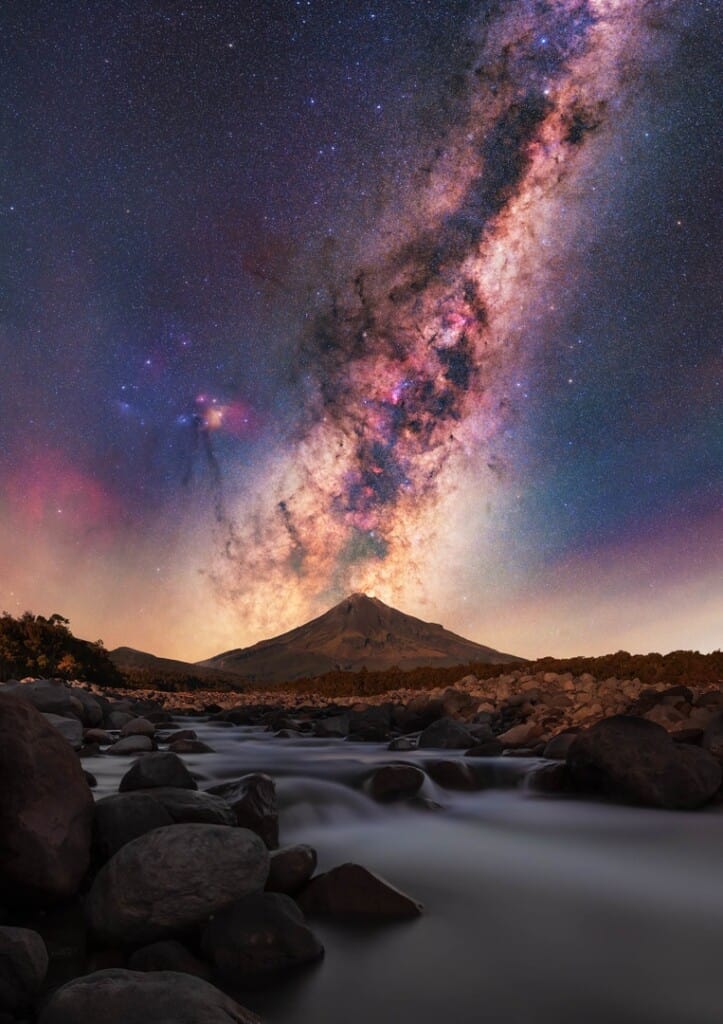
Brendan Larsen waited until 2:30 in the morning for the galaxy to align with the peak of Mount Taranaki.
The mountain is a near-perfect volcanic cone on New Zealand’s North Island. It looks almost artificial, like someone designed it specifically to anchor a Milky Way photograph.
New Zealand is one of the top night sky destinations in the world. Large parts of the South Island carry International Dark Sky Reserve status, which means the skies there are actively protected from light pollution.
7. South of Home — Lorenzo Ranieri Tenti | Namibia
Namibia is one of the darkest countries on Earth. Light pollution there is almost nonexistent outside the capital.
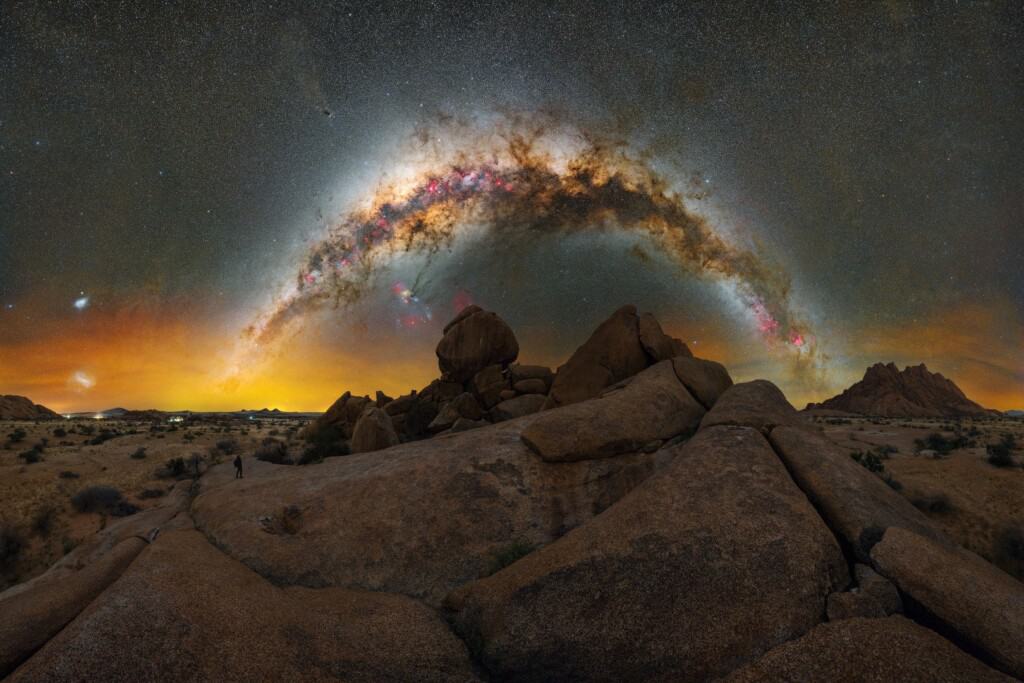
Lorenzo Ranieri Tenti photographed ancient granite boulders in the Gross Spitzkoppe Nature Reserve with the Milky Way arching overhead in a warm golden glow.
Those boulders are hundreds of millions of years old.
Standing under the galaxy next to rocks that old puts human existence into a perspective that is hard to describe. This image makes you feel it anyway.
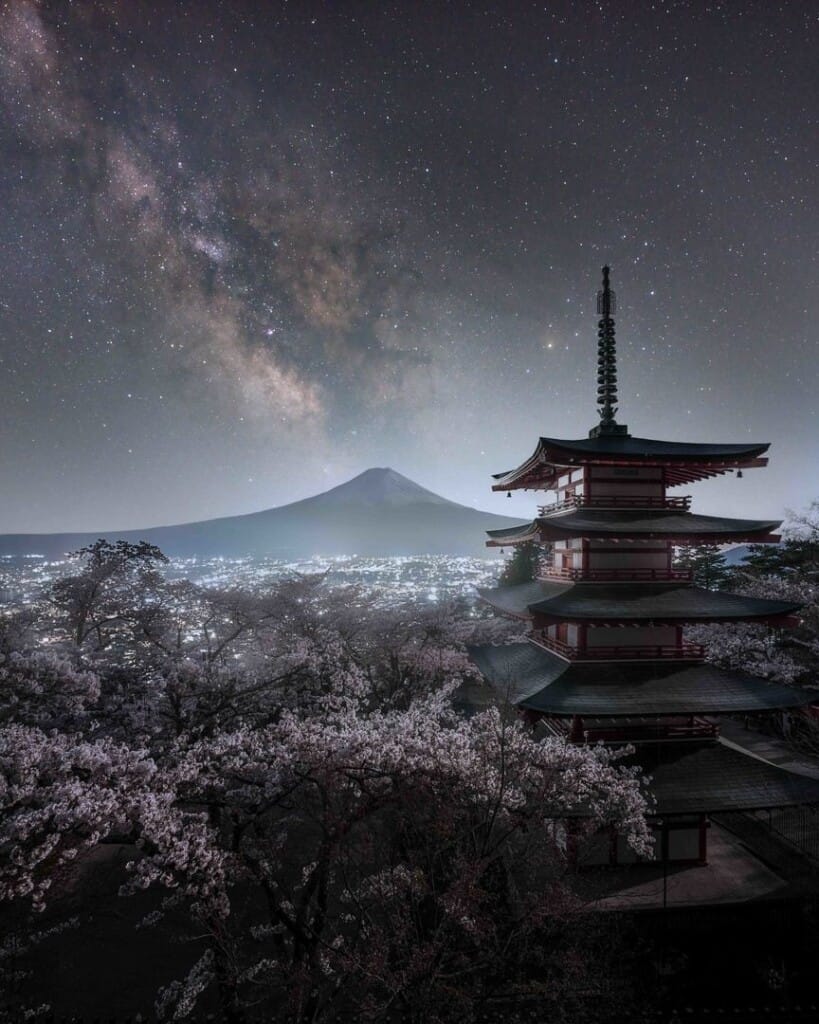
8. The Scenery I Wanted to See — Mitsuhiro Okabe | Japan
Cherry blossom season in Japan lasts roughly two weeks per year. The galactic center is only in the right position for a few hours per night during that window.
Mitsuhiro Okabe found the overlap between all three and photographed Mount Fuji, a Shinto shrine, and cherry blossoms in full bloom beneath the Milky Way. The image feels mythological: ancient Japan, fleeting spring, eternal space. Everything temporary except the galaxy.
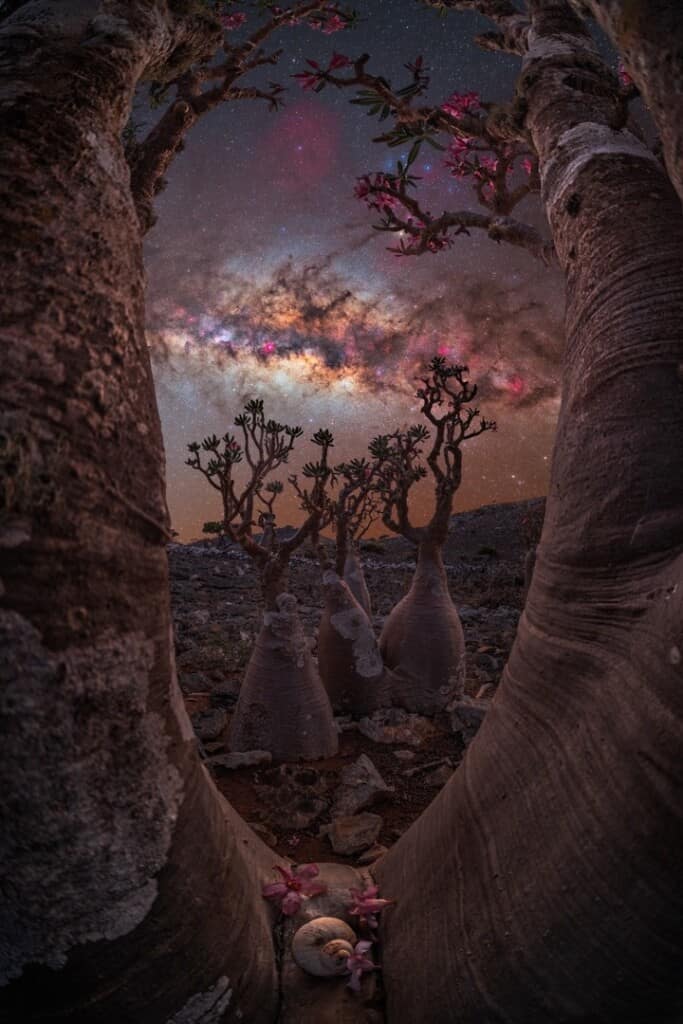
9. The Bottle Tree Portal — Benjamin Barakat | Socotra Island, Yemen
Socotra Island sits in the Arabian Sea off the coast of Yemen. It is one of the most isolated places on Earth.
Hundreds of species there exist nowhere else. The Bottle Trees of Socotra look like something from a science fiction film, twisted trunks and spreading canopies shaped by thousands of years of island wind.
Benjamin Barakat photographed them in bloom, their pink flowers matching the pink tones in the night sky above. Socotra is a UNESCO World Heritage Site. Very few photographers ever make it there.
This image looks like another planet. It is ours.
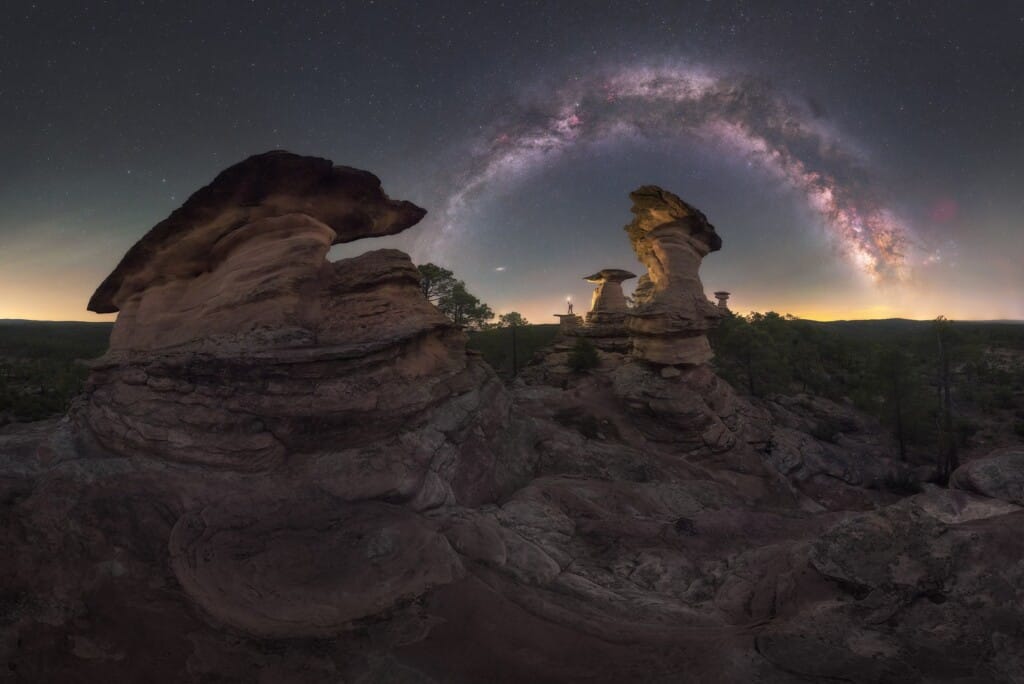
10. Milky Way Over Cuenca’s Hoodoos — Luis Cajete | Spain
Hoodoos are narrow limestone towers shaped by centuries of erosion.
The Serrania de Cuenca region in central Spain has some of the most dramatic ones in Europe, and skies dark enough to photograph the Milky Way above them.
Luis Cajete’s image is a reminder that extraordinary night sky locations exist on every continent, sometimes just a few hours from a major city.
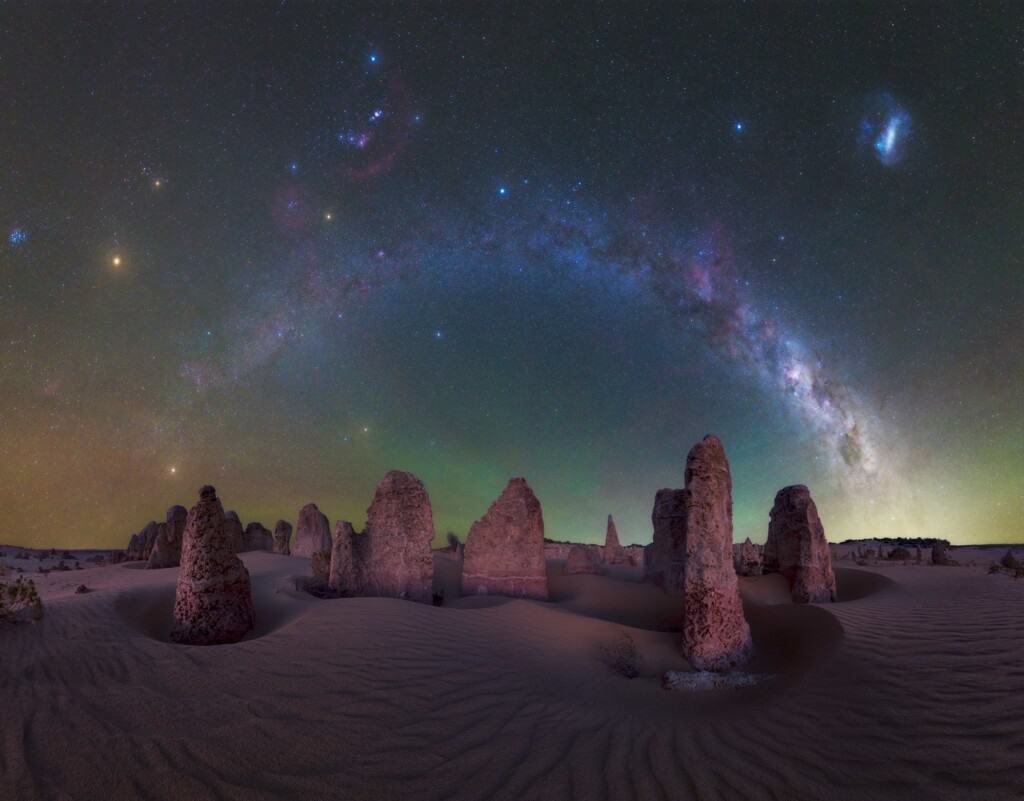
11. Interstellar — Jose Luis Cantabrana Garcia | Australia
The Pinnacles Desert in Western Australia is covered in thousands of limestone columns rising from yellow sand. It looks like the surface of another world.
Jose Luis Cantabrana Garcia photographed it after seeing the location in a previous Capture the Atlas collection.
That is the ripple effect Dan Zafra talks about. One image sends a photographer to a place they had never considered. Their image then does the same for someone else.
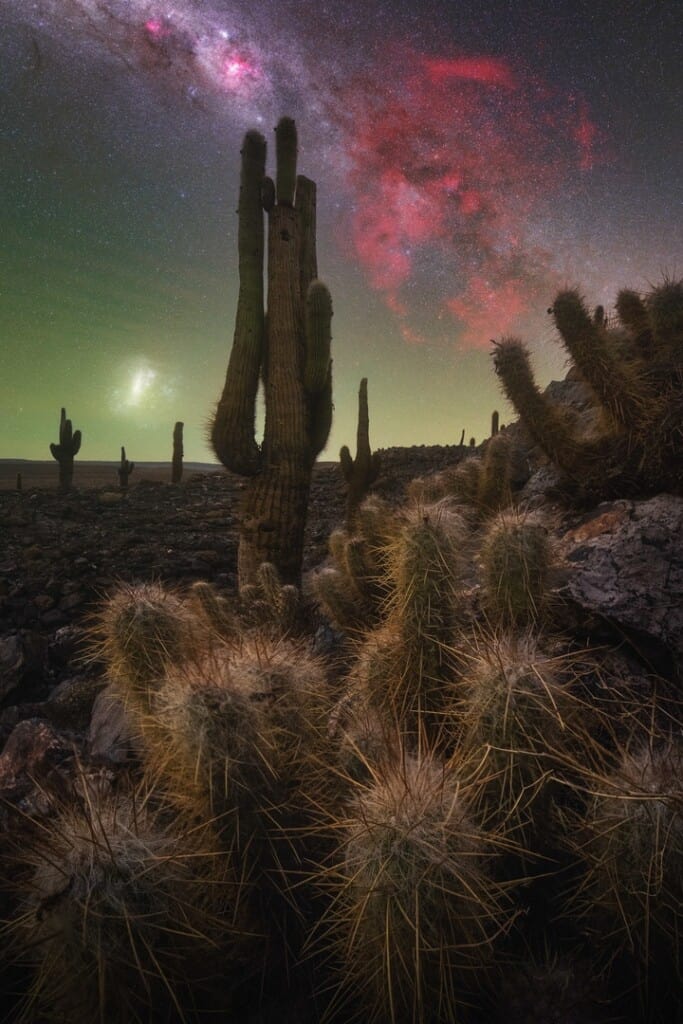
12. The Cactus Valley — Pablo Ruiz García | Chile
The Atacama Desert is the best place on Earth to photograph the night sky. Full stop.
It sits at high altitude with almost zero humidity and no major cities for hundreds of miles in any direction. The air is so clear that features of the Milky Way visible only in photographs elsewhere can sometimes be seen with the naked eye.
Pablo Ruiz García captured the galactic core alongside the Magellanic Clouds, two small companion galaxies visible only from the Southern Hemisphere, and the faint sweep of the Gum Nebula, the remnant of an ancient stellar explosion.
13. Night Under the Baobab Trees — Steffi Lieberman | Madagascar
Some of the baobab trees on the Avenue of the Baobabs in Madagascar are over 1,000 years old.
They were ancient when modern astronomy began. They will likely still be standing when our grandchildren’s grandchildren are gone.
Steffi Lieberman photographed the full arc of the Milky Way stretching over their canopies. The trees in the foreground and the galaxy above are each operating on timescales that make human life feel like a blink.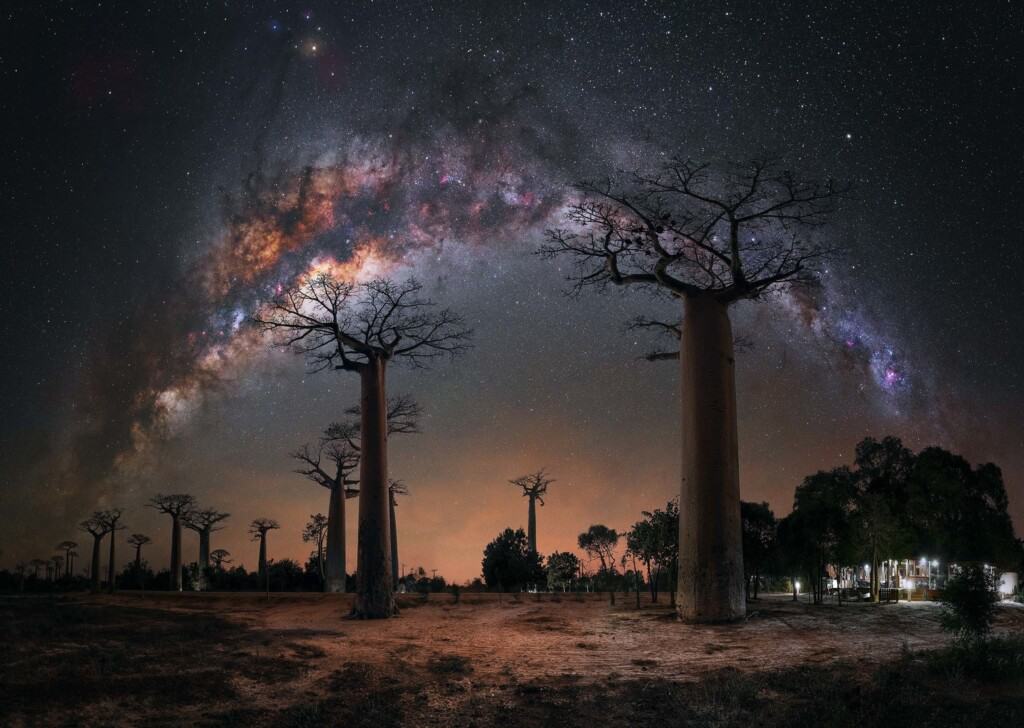
13. Night Under the Baobab Trees — Steffi Lieberman | Madagascar
Some of the baobab trees on the Avenue of the Baobabs in Madagascar are over 1,000 years old.
They were ancient when modern astronomy began. They will likely still be standing when our grandchildren’s grandchildren are gone.
Steffi Lieberman photographed the full arc of the Milky Way stretching over their canopies. The trees in the foreground and the galaxy above are each operating on timescales that make human life feel like a blink.
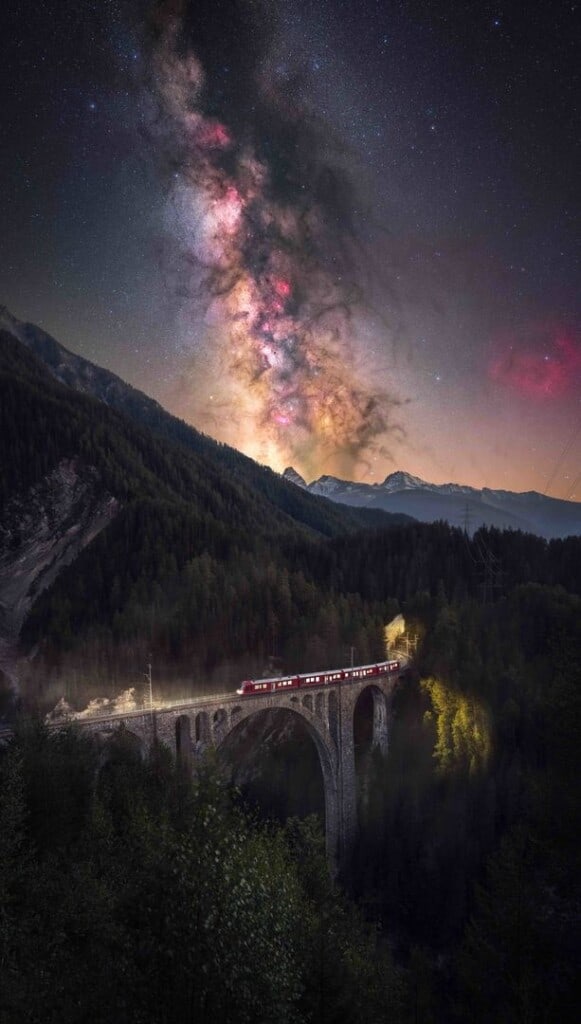
14. The Night Train — Alexander Forst | Switzerland
Alexander Forst photographed the Wiesener Viaduct in Graubünden, Switzerland on separate nights: one for the night sky and one for the train passing through with its lights on. He then blended every element into a single seamless image.
Every part of the photograph is real. Nothing was invented. The challenge was capturing each element at its best and combining them without it looking artificial.
The result is technically impossible to achieve in a single shot. You would never know that looking at it.
15. Gigi Hiu Shining in the Dark — Gary Bhaztara | Indonesia
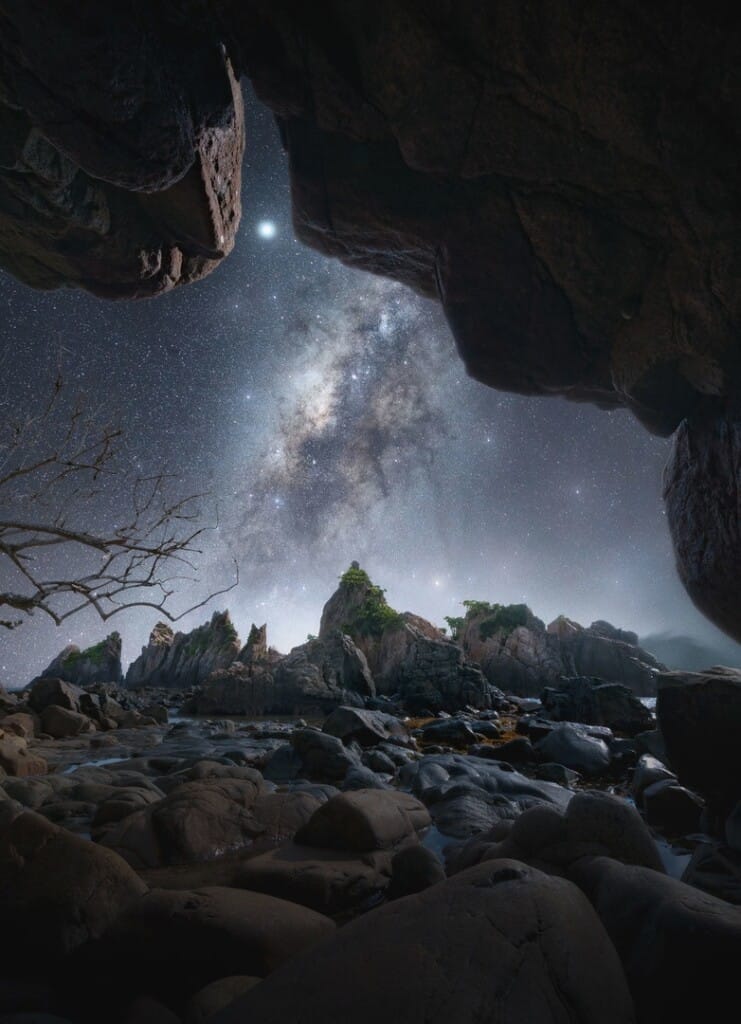
Shark Teeth Beach in Sumatra gets its name from the jagged black rock formations along the shore.
Gary Bhaztara photographed those formations against the sweep of the Milky Way overhead. The sharp angular silhouette of the rocks against the soft glowing arc of the galaxy creates a contrast that pulls your eye across the entire frame.
Indonesia sits on the equator. The Milky Way rises high in the sky there and is visible for much of the year. Photographers at higher latitudes never get angles like this.
How to Photograph the Milky Way: A Simple Starting Point
You do not need expensive gear to start. You need the right conditions and a little preparation.
- Go when the galactic core is visible. In the Northern Hemisphere that window runs from roughly February to October. June and July offer the best views when the core rises high after dark. In the Southern Hemisphere the season is longer: January through November, with the best shooting from April to August.
- Shoot around the new moon. Even a half moon is enough to wash out the Milky Way. Pick nights within a few days of the new moon when the sky stays dark all night.
- Find dark skies. This is the most important factor. Use a free light pollution map online to find areas near you rated Bortle 4 or lower. National parks, rural farmland, and designated dark sky reserves are good starting points.
- Start with these camera settings: wide-angle lens between 14mm and 24mm, aperture at f/1.8 to f/2.8, ISO between 1600 and 6400, shutter speed between 15 and 25 seconds. Adjust from there based on what you see.
- Use PhotoPills or Stellarium. Both apps show you exactly where the Milky Way will appear at any location and time. Plan your compositions before you leave home.
The first time you nail a shot and see the galaxy in your viewfinder, you will understand why these photographers drive hours into the dark.
Source: Capture the Atlas