Engineering Junkies
  • HOME
  • News
  • Technology
    • AI
    • Robotics
  • Science
  • Gadgets
  • Transport
    • Cars
No Result
View All Result
  • HOME
  • News
  • Technology
    • AI
    • Robotics
  • Science
  • Gadgets
  • Transport
    • Cars
No Result
View All Result
Engineering Junkies
No Result
View All Result
Home Technology

Meet Musashi Japan’s Future AI Taxi Driver

Engineering Junkies by Engineering Junkies
30/04/2026
in Robotics, Technology
A A
Share on FacebookShare on Twitter

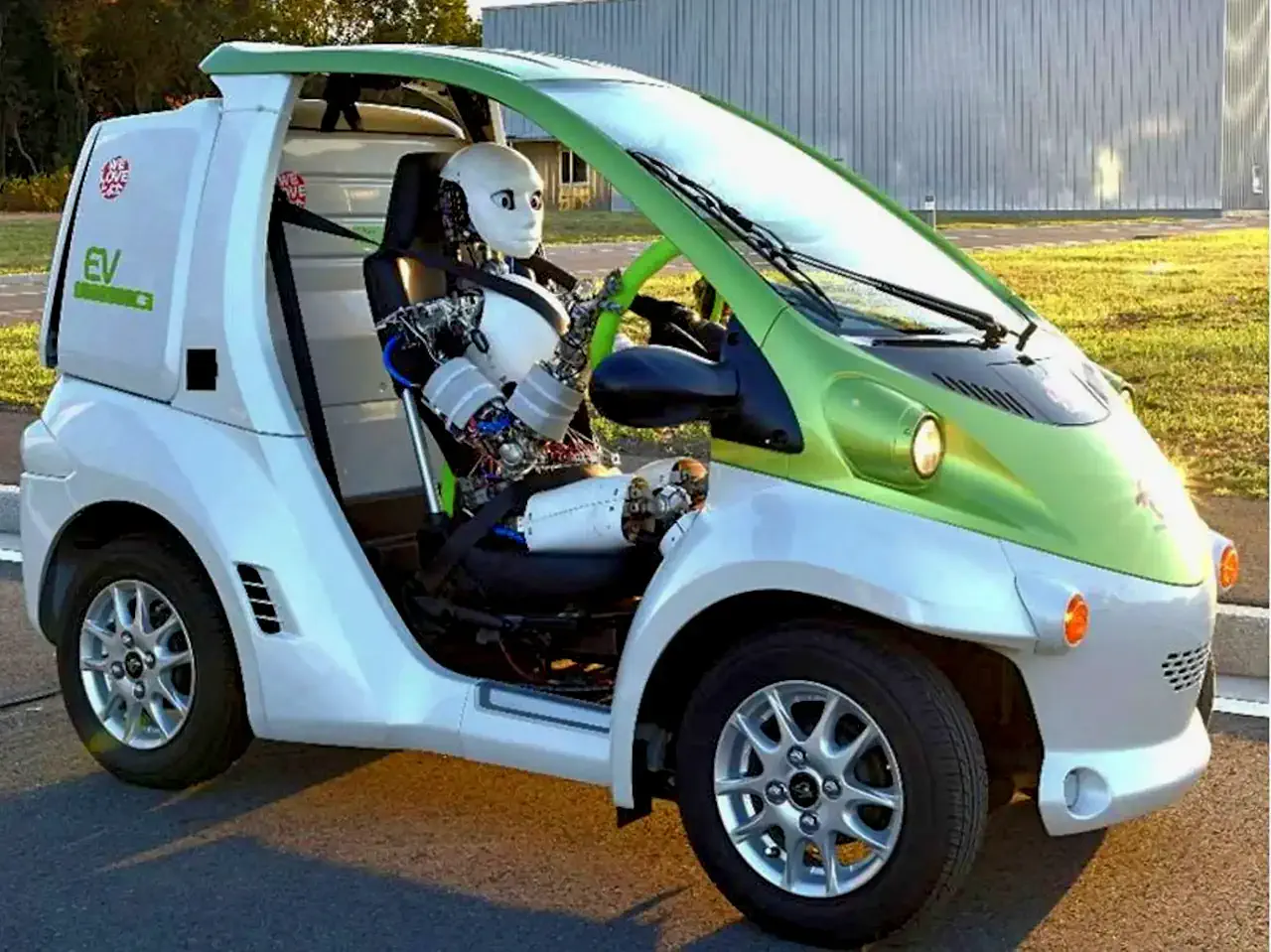
Musashi Humanoid Robot in micro car

A Different Direction in Driverless Car Technology

Driverless cars are usually built around software cameras radar and sensors that allow the vehicle to drive on its own. But researchers at the University of Tokyo are exploring a very different idea.

Instead of removing the human driver role completely they are using a humanoid robot that physically sits in the driver seat and operates the car like a person.

The robot is called Musashi and it is designed to act and move in a human like way so it can use real driving controls.

University of Tokyo Musashi Humanoid Robot Driving a Micro Car

What Musashi Is and How It Was Built

Musashi is a musculoskeletal humanoid robot developed in 2019 as a research platform for studying human movement and control systems. It is not a stiff industrial robot. It is designed to imitate the structure of the human body more closely.

It has 74 artificial muscles and 39 joints not including its hands. These muscles work in opposing pairs similar to how human muscles function. The structure includes joint modules muscle modules and strong Dyneema fibers for durability.

It also uses a nonlinear elastic unit based on rubber like material which helps create flexible and smooth motion similar to human movement.

The goal of this design is to help researchers understand how natural motion and balance can be recreated in machines.
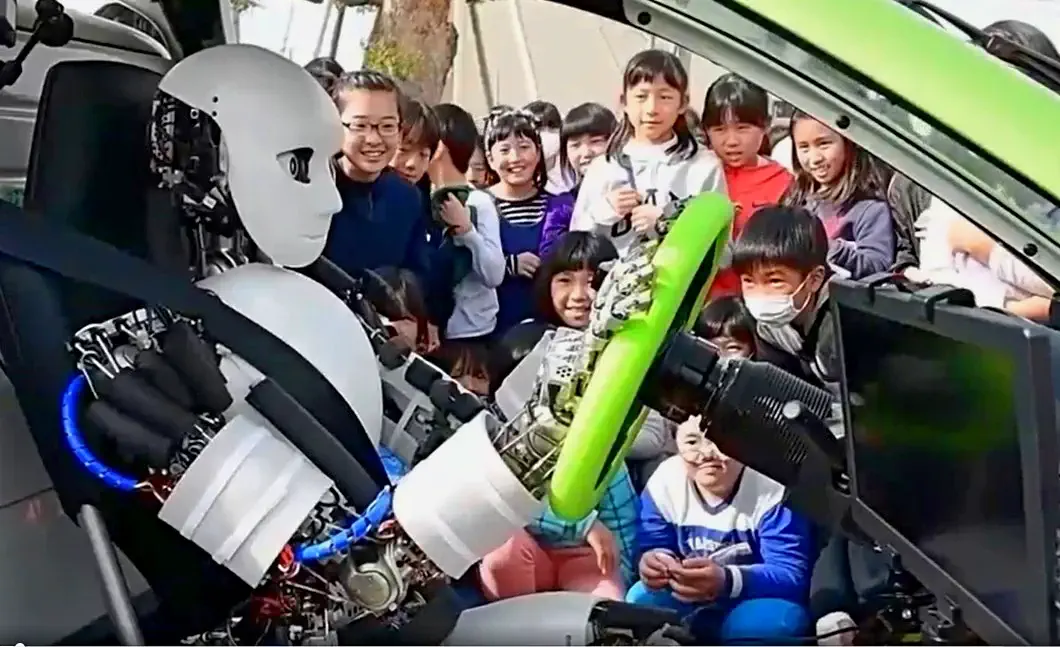
University of Tokyo Musashi Humanoid Robot Inside Mini Car

How Musashi Sees and Controls the Car

Musashi has a human shaped upper body with two arms two legs and a head. Each eye contains a high resolution camera that can move up down and sideways. This allows it to look forward check mirrors and quickly scan its surroundings.

The robot also has sensors in its joints muscles hands and feet to measure force and movement in real time. This helps it adjust pressure when pressing pedals or turning the steering wheel.

A compact computer system including a Wi Fi router and Intel NUC was installed in the test vehicle. This system processes vision data and controls servo motors that move the robot.

Driving Experiments in a Real Car

Researchers tested Musashi in a Toyota COMS electric microcar. The robot was placed in the driver seat and allowed to operate all basic driving functions.

Musashi used its feet to control the brake and accelerator pedals. It used its hands to turn the steering wheel operate the handbrake switch indicators and ignition key.

During one test the robot was able to release the brake and complete a slow two minute turn at a controlled speed without using the accelerator. This showed that it could manage basic motion control using balance and sensor feedback.

In another test Musashi successfully approached a junction and reacted correctly to traffic lights. It was able to detect signals and respond by stopping or moving forward when appropriate.

The system was also tested for obstacle detection where it had to recognize humans in its path and react safely.

Limitations Found During Testing

During testing, Musashi was able to complete several driving tasks, but it also showed some clear weaknesses.

The robot had trouble keeping a steady speed when going uphill. It also found it difficult to smoothly manage the accelerator while keeping proper balance, especially in more complex driving situations.

These issues suggest that the system can work in controlled settings, but it still needs a lot of improvement before it could be used safely on real roads.

Why Researchers Chose This Approach

The purpose of this research is not to replace today’s self-driving systems. Instead, it focuses on understanding how a human-like body can physically operate real driving controls.

Most autonomous cars today depend mainly on software that directly controls steering, braking, and acceleration. Musashi takes a different path by acting more like a human driver inside a real car.

This allows researchers to study how machines can learn better physical coordination, improve decision-making, and respond to real-world conditions in a more natural way.

Future Possibilities

Musashi is still in the experimental phase, but it points to interesting future possibilities in robotics and mobility research.

In the future, similar humanoid systems could be used to help train and test autonomous driving technologies in real-world environments. They could also reduce the need for human drivers during vehicle testing.

Over time, researchers hope this approach could lead to robots that move and react more like humans, making them better at interacting safely with vehicles, machines, and real-world situations.

Source: University of Tokyo
Tags: NewsRoboticsTechnology
Previous Post

Tesla’s Massive Stockpile of Unsold Cars Is Visible from Space

Next Post

Sirius Aviation Unveils Hydrogen Jet That Costs $500 to Refuel

Related Posts

Samsung's New Solid state EV Battery offers 600-Mile Charge in 9 Minutes and 20-Year Lifespan

Samsung New Solid-State Battery Power 600-Mile EVs in Minutes

25/05/2026

Samsung Moves Closer to EVs with 600-Mile Range and Ultra-Fast Charging I’ve been covering the EV space for years, and...

During the Tests, Flycart 30 Reached a Height of 6,191.8 Meters on Mount Everest

Mount Everest’s First Drone Delivery: A Game-Changer

25/05/2026

During the Tests, Flycart 30 Reached a Height of 6,191.8 Meters (20,314 Feet) on Mount Everest Mount Everest has seen...

Project Crystal Lenovo's Transparent MicroLED Laptop

Project Crystal Lenovo’s Transparent MicroLED Laptop

25/05/2026

Project Crystal Lenovo's Transparent MicroLED Laptop | Photo by Sam Rutherford/Engadget The first time you see Lenovo's Project Crystal in...

This screenshot displays Google Gemini to generate an AI-created image of a pope

Google Pauses AI Image Tool After It Refused to Show White People

07/05/2026

This Screenshot Shows CNN requesting Google Gemini to Generate an AI-created image of a Pope, Along with the AI Response....

Do electric vehicles catch fire more than gas cars comparison between EV and gasoline vehicle fires
Transport

Do Electric Vehicles Catch Fire More Than Gas Cars?

12/05/2026
FD&C Yellow 5 (tartrazine), the dye that gives foods, drugs, and cosmetics a lemon-yellow color, can also be used to make mice transparent, as shown in this generative image.
Science

Scientists Make Mouse Skin Transparent Using Common Food Dye

30/04/2026
China ultra-high-speed UHS 1000 kmh Maglev Train Successfully Passes Demo Test
Transport

China Tests 1,000 km/h Maglev Train Successfully

30/04/2026
Samsung's New Solid state EV Battery offers 600-Mile Charge in 9 Minutes and 20-Year Lifespan
Technology

Samsung New Solid-State Battery Power 600-Mile EVs in Minutes

25/05/2026

Subscribe

FD&C Yellow 5 (tartrazine), the dye that gives foods, drugs, and cosmetics a lemon-yellow color, can also be used to make mice transparent, as shown in this generative image.
Science

Scientists Make Mouse Skin Transparent Using Common Food Dye

30/04/2026
Yamaha's prototype hydrogen outboard and vessel on show at Miami Boat Show 2024
Transport

Yamaha Unveils Hydrogen-Powered Outboard Motor for Boats

17/05/2026
Scientists are exploring how Toxoplasma gondii, a parasite in cat feces, might help treat Alzheimer's and Parkinson's
Science

Parasites Found in Cat Poop Could Cure Alzheimer’s and Parkinson’s

30/04/2026
China ultra-high-speed UHS 1000 kmh Maglev Train Successfully Passes Demo Test
Transport

China Tests 1,000 km/h Maglev Train Successfully

30/04/2026
engineering-junkies-3d-logo

Engineering Junkies

A Publication Led by a Team of Expert Researchers in Technology, Science, and Current Events. Stay Informed by Joining Our Community Today.

Follow Us

Categories

  • DIY & Home Improvement
  • Engineering
  • Gadgets
  • News
  • Science
  • Technology
    • AI
    • Robotics
  • Transport
    • Cars

Company

  • About Us
  • Advertise
  • Contact Us
  • Cookie Policy
  • Editorial Guidelines
  • Home
  • Legal Policies
  • Privacy Policy
  • Terms of Service

Recent News

Do electric vehicles catch fire more than gas cars comparison between EV and gasoline vehicle fires

Do Electric Vehicles Catch Fire More Than Gas Cars?

12/05/2026
FD&C Yellow 5 (tartrazine), the dye that gives foods, drugs, and cosmetics a lemon-yellow color, can also be used to make mice transparent, as shown in this generative image.

Scientists Make Mouse Skin Transparent Using Common Food Dye

30/04/2026
China ultra-high-speed UHS 1000 kmh Maglev Train Successfully Passes Demo Test

China Tests 1,000 km/h Maglev Train Successfully

30/04/2026

© Copyright 2023 -All Rights Reserved by Engineering Junkies.

No Result
View All Result
  • Home
  • News
  • Technology
    • AI
    • Robotics
  • Science
  • Gadgets
  • Transport
    • Cars
  • Engineering

© Copyright 2023 -All Rights Reserved by Engineering Junkies.